Top 15 Best Reverse Osmosis Water Filter You Can’t Miss
Many people have faced taste issues, slow flow rates, or frequent leaks with poorly made water filters. Choosing the best reverse osmosis water filter is key to avoid these problems and ensure clean, reliable drinking water.
A cheap or mismatched system often fails to remove contaminants properly or wastes water, leading to frustration and extra expense.
A good reverse osmosis filter usually has multiple filtration stages including sediment, carbon, and the RO membrane itself, which should have a rejection rate above 90%. Materials like FDA-approved food-grade plastics and high-quality membranes make a significant difference in safety and durability.
Size also matters; a compact unit with clear installation steps helps maintain the system, while flow rate closer to 50 gallons per day suits most household needs without long wait times.
Need a Quick Check?
| Image | Product | Price |
|---|---|---|
Our Top Picks 1  | Waterdrop G3P600 RO System | Check Price |
Our Top Picks 2  | Bluevua RO100ROPOT Countertop | Check Price |
Our Top Picks 3  | Waterdrop G3P800 RO System | Check Price |
Our Selected Top 15 Reverse Osmosis Water Filter You Can Trust
This list features carefully chosen reverse osmosis water filters, highlighting their purification performance, ideal user types, and key advantages and disadvantages. Each review provides clear insights to help you find the most suitable option based on your specific needs and preferences.
1. Waterdrop G3P600 Reverse Osmosis Water Filter System
Waterdrop G3P600 Reverse Osmosis Water Filter System offers thorough purification for those wanting seriously clean water straight from the tap. Its biggest strength lies in its 8-stage filtration that tackles a wide range of contaminants, making it suitable for households with concerns about water quality and safety.
Installation happens under the sink, and it connects to a smart display faucet that shows filtration status. The tankless design helps save space, while the 2:1 low drain ratio means less water waste.
Running at a maximum flow rate of 0.42 gallons per minute, it keeps pace with everyday water use without delays.
Effectively reducing contaminants like chromium, PFAS, fluoride, and chlorine is one of its strong suits. The build quality feels solid and reliable, with NSF and other certifications confirming safety and performance.
Most praise points to the high filtering capacity and clarity of display, while some mention the need for corded power as less convenient.
The system handles a wide range of contaminants effectively, offering confidence in water purity. Most users appreciate the clear smart display but note that needing a corded power source can be inconvenient depending on kitchen layout.
Anyone wanting high-level filtration with clear usage info under the sink will be happy. It’s less suitable where power outlets are scarce or a faster flow rate is critical.
Pros
- Certified for extensive contaminant removal
- Space-saving tankless design under sink
- Smart display faucet with filtration status
- Low water waste with 2:1 drain ratio
Cons
- Requires corded electric power
- Flow rate might feel slow in busy kitchens
| Specification | Details |
|---|---|
| 8-stage Filtration | Yes |
| Maximum Flow Rate | 0.42 gpm |
| Drain Ratio | 2:1 |
| Power Source | Corded Electric |
| Supported Water TDS Level Maximum (PPM) | 1500 |
| Operating Pressure Range | 87 psi |
2. Bluevua RO100ROPOT Countertop Reverse Osmosis System
Having clean, mineral-enriched water on the counter feels refreshing and convenient with this system designed for people wanting easy, no-installation filtering. Its biggest strength is the multi-stage filtration with UV light that ensures not only purity but also balanced taste and health benefits without needing plumbing.
Setup requires just placing the system on your countertop and plugging it in, making it simple to start using right away. The included borosilicate glass carafe stores filtered water safely, and the built-in TDS meter helps you monitor water quality daily. It’s compact and portable, making it easy to move or store, and it runs on a standard corded electric power source.
Filtration performs well, reducing contaminants like lead, fluoride, and chlorine while adding essential minerals back to the water. The 6-stage filtration including UV light is reliable and thorough. Its build feels solid, especially the glass carafe, though the flow rate is on the slower side at 0.26 liters per minute.
Common positive notes highlight pure taste, with some mentioning the limited flow speed as the main downside.
The system is praised for delivering pure, mineral-rich water with a noticeable improvement in taste. Most users mention the slow flow rate as a hassle, especially when filling larger amounts of water.
People looking for an easy, portable countertop filtration without installation will be satisfied. Those needing faster water output or cordless use may want to explore other options.
Pros
- Advanced 6-stage filtration with UV light
- No plumbing or installation required
- Includes built-in TDS meter for water monitoring
- Borosilicate glass carafe keeps water pure
Cons
- Slow flow rate at 0.26 liters per minute
- Requires constant electrical connection to operate
| Specification | Details |
|---|---|
| Maximum Flow Rate | 0.26 liters per minute |
| Container Type | Borosilicate Glass Carafe |
| Power Source | Corded Electric |
| Filter Life Cycle | 12 months |
| Operating Pressure Range | 60 psi |
3. Waterdrop G3P800 Reverse Osmosis Water Filter System
Excellent for anyone wanting thoroughly filtered water, the Waterdrop G3P800 delivers strong contaminant removal through its 10-stage filtration. Its major plus is reducing harmful substances like lead, fluoride, and even radioactive particles, making it a solid choice for households focused on water safety and quality.
Installation happens under the sink, and setup is straightforward despite the system’s advanced features. The tankless design keeps your space neat, while the smart faucet with LED indicator adds convenience by showing filter status at a glance. Day-to-day use involves no bulky storage, just fresh water on demand with a good flow rate suited for regular family needs.
Performance-wise, it handles tough contaminants well, certified to NSF/ANSI standards for several key reductions, including total dissolved solids and chlorine. The build reflects modern standards with a tankless design that avoids chlorine taste and odor effectively. A common complaint is the power requirement since it needs corded electric setup, which might complicate placement for some.
It earns praise for removing a wide range of pollutants, including heavy metals and radioactive substances, confirmed by third-party tests. Users note the smart faucet and tankless design as practical features, though some find the electric setup limiting for counter placement.
People prioritizing comprehensive water purification and modern design will appreciate it. Those lacking easy access to a power outlet or wanting a simple manual setup might consider alternatives without a power requirement.
Pros
- Effective 10-stage filtration reduces many contaminants
- Tankless design saves under-sink space
- Smart faucet with LED shows filter status
- High daily capacity suits family use
Cons
- Requires corded electric power source
- May need professional installation help
| Specification | Details |
|---|---|
| Filtration Stages | 10-Stage RO Filtration |
| Capacity | 800 GPD high capacity |
| Flow Rate | Maximum Flow Rate 3028 liters_per_day |
| Power Source | Corded Electric |
| Temperature Range | 41 °F to 100 °F |
| Certifications | NSF/ANSI 42, 53, 58, 372 Certified |
4. Waterdrop X8-WAN Alkaline Reverse Osmosis System

Built with a tankless design and a 10-stage filtration system, the Waterdrop X8-WAN Alkaline Reverse Osmosis System suits those looking for pure water with the added benefit of essential minerals. Its main strength lies in combining a precise 0.0001 μm RO membrane with mineralization for balanced, clean drinking water.
Setup involves installing the system under the sink, powered by corded electric supply. Daily use is simple thanks to its dispenser container type, fitting easily into kitchen spaces without the bulk of a traditional tank. The system supports water with TDS levels up to 500 ppm, and the filters are designed to last for 24 months, reducing the need for frequent replacements.
Filtration performance is impressive, with the ability to remove impurities such as PFOA, PFOS, chlorine, fluoride, and lead, supported by NSF/ANSI certifications. The 16-layer 0.0001 μm membrane ensures thorough purification. The unit is generally praised for water taste improvement, though some users note the setup can be a bit intricate.
Its build reflects solid construction designed for long-term use.
The Waterdrop X8-WAN receives strong praise for the clean, mineral-rich taste it provides through its 10-stage filtration and alkaline technology. The most noted drawback is the complexity of installation compared to simpler filtration systems.
People wanting high-quality purified water with added minerals and space-saving design will be satisfied. Those looking for a filter that works without electricity or prefers very simple set-up might want to explore other options.
Pros
- Removes particles larger than 0.0001 μm
- Adds essential minerals like Ca²⁺ and Mg²⁺
- Tankless design saves space under the sink
- Long 24-month filter lifespan
Cons
- Installation can be somewhat complicated
- Requires electric power to operate
| Specification | Details |
|---|---|
| Purification Method | Reverse Osmosis |
| Filter Life Cycle | 24 months |
| Installation Type | Under Sink |
| Power Source | Corded Electric |
| Supported Water TDS Level Maximum | 500 PPM |
| Lower Temperature Range | 41 °F |
5. DREO Countertop Reverse Osmosis Water Filter System

A standout feature is the built-in TDS meter and real-time monitoring, perfect for those who want to keep a close eye on their water quality. Great for anyone seeking a countertop purification system that combines convenience with strong contaminant removal, it’s especially reassuring for homes concerned about lead, fluoride, and chemical contaminants.
Setting it up involves simply placing it on your countertop, no complicated installation needed. Day-to-day use is straightforward with the auto-fill sensor doing the refills, so no manual topping off is required.
The self-cleaning system also takes care of flushing internal tubes without you having to think about it. Touch controls make for easy operation, and filter change reminders pop up when maintenance is due, simplifying upkeep.
It does an excellent job of cutting down contaminants, meeting NSF/ANSI 58 standards with a 0.0001 μm RO membrane that tackles 99% of lead and chlorine and nearly all fluoride. The unit feels solid and well designed to sit on the counter, with a focus on long filter life lasting about six months. The most praised aspect is its reliable purification and convenient hands-off refill process.
On the downside, some users find the maximum supported water TDS level of 500 ppm limiting for very hard or heavily contaminated water sources.
Reliable removal of lead and fluoride along with the auto-fill feature are praised for combining effective purification with ease of use. Some users find the 500 ppm TDS limit restrictive, which can be a drawback in areas with highly contaminated water.
People who want straightforward water quality tracking and a no-fuss daily refill will be pleased. A household dealing with exceptionally hard water or very high TDS may want to consider alternatives with higher capacity or more intensive filtration capabilities.
Pros
- Real-time TDS monitoring for water quality
- Auto-fill sensor allows hands-free refills
- Self-cleaning system flushes internal tubes
- Touch control simplifies operation
Cons
- Maximum supported TDS level capped at 500 ppm
- Filter needs replacing every six months
| Specification | Details |
|---|---|
| Purification Method | Reverse Osmosis |
| Supported Water TDS Level Maximum (PPM) | 500 |
| Filter Life Cycle | 6 months |
| Container Type | Dispenser |
| Installation Type | Countertop |
| Other Features | Built In TDS Meter, Change Filter Indicator, Auto-Fill, Self-Cleaning |
6. Waterdrop G5P500A Reverse Osmosis Water Filter

Choosing high-purity water often means settling for bulky setups, but the Waterdrop G5P500A turns that on its head with an advanced 8-stage filtration system wrapped in a compact, tankless design. Perfect for kitchens that need space-saving without compromising on filtering, it excels in delivering mineral-rich, clean water fast.
Installation goes under the sink and involves connecting the system to your water supply with included parts. Once set, the electric-powered system runs quietly and doesn’t require a storage tank, so access to fresh water is immediate. The 2:1 pure to drain ratio helps reduce waste, and the flow rate of 1.31 liters per minute keeps water coming steadily for drinking and cooking.
Filtration performs strongly, efficiently removing contaminants down to 0.0001 microns while adding beneficial minerals like calcium and magnesium. The build feels solid with a focus on compactness and quiet operation.
Praise often points to clean-tasting water free from odors, while the most noted downside involves the upfront installation complexity for those not handy with plumbing.
The system is well-liked for delivering clean, great-tasting water without the bulk of a traditional tank, making it easy to fit in tighter spaces. A common challenge is the installation process, which might be difficult without basic plumbing skills or professional help.
Those seeking high-quality filtered water with added minerals and limited footprint will appreciate this model. Users wanting a simple plug-and-play or a non-electric option might want to explore other filters better suited to their needs.
Pros
- Includes mineralization for balanced water taste
- Compact design saves under-sink space
- High-capacity filtration handles heavy use
- Low waste with 2:1 pure to drain ratio
Cons
- Installation can be complex for beginners
- Requires electric power to operate
| Specification | Details |
|---|---|
| Filtration stages | 8-stage Filtration |
| Capacity | 500GPD High Capacity |
| Reservoir type | Compact tankless design |
| Flow rate | 1.31 liters per minute |
| Operating pressure range | 14.5-87 psi |
| Power source | Corded Electric |
7. APEC ROES-50 Under Sink Reverse Osmosis System

Hard water and unwanted chemicals in tap water can be a daily concern for many households. Ideal for those looking for high-quality drinking water directly from their kitchen sink, this system’s biggest strength lies in its ability to remove up to 99.99% of impurities, ensuring pure, great-tasting water for the entire family.
Setting up the system under the sink is straightforward thanks to labeled tubing and quick-connect fittings that make installation manageable even without professional help. Filters last around six months, meaning maintenance is infrequent but important. The system works quietly and steadily, providing a continuous supply of purified water without needing a lot of space or complicated controls.
Performance-wise, the multi-stage filtration impresses by efficiently cutting out arsenic, fluoride, lead, chlorine, and even microplastics, ensuring safe water. It’s made with durable materials suited for daily use under typical household water pressure and temperature ranges.
The main compliment highlights the quality and taste of the water, while the most frequent downside is the relatively slow flow rate at 0.03 gallons per minute.
The system delivers excellent water quality with a reliable multi-stage filtration process that leaves users impressed by the clarity and taste. A common complaint relates to how slow the water flows compared to other filtration options, which might be noticeable during heavy use or refilling larger containers.
This setup suits anyone who prioritizes pure water and doesn’t mind waiting a bit for filtration. Larger families or those needing faster water output might want to explore options with higher flow rates or additional storage tanks to avoid slow dispensing.
Pros
- Removes over 1000 impurities including heavy metals
- Easy DIY installation with color-coded tubing
- Produces up to 50 gallons per day
- Long-lasting filters reduce maintenance frequency
Cons
- Slow water flow rate of 0.03 gpm
- Requires regular filter replacement every six months
| Specification | Details |
|---|---|
| Maximum Flow Rate | 0.03 gpm |
| Filter Life Cycle | 6 months |
| Operating Pressure Range | 40-85 psi |
| Lower Temperature Range | 40 °F |
| Upper Temperature Rating | 100 °F |
| Supported Water TDS Level Maximum | 2000 PPM |
8. Waterdrop G6A6 Alkaline Reverse Osmosis System

Ultra-compact tankless design saves up to 81.8% more under-sink space compared to traditional reverse osmosis systems, making it ideal for kitchens where space is tight. Perfect for anyone who wants safe, clean water without sacrificing valuable storage room under the sink.
Installation fits neatly under the sink without a bulky tank, freeing up room for cleaning supplies or garbage disposals. Daily use is straightforward: just turn on the faucet to get alkaline, filtered water.
The filter life cycle lasts 24 months, so it doesn’t require frequent replacements. Being certified lead-free adds confidence when drinking or cooking with the water.
Purifies effectively through reverse osmosis with up to 99% contaminant reduction confirmed by SGS testing. The build is compact yet solid and made from safe materials, certified by IAPMO R&T to meet NSF/ANSI/CAN 372 standards. Praise highlights how much space it saves, though some mention the tankless design means water flow may feel different from traditional systems.
Space-saving is the strongest benefit, with users appreciating the compact tankless design that frees up under-sink room. The most common drawback revolves around the water flow, which can differ from traditional RO units that store filtered water in a tank. This may feel unusual to those used to standard systems.
Homes with limited under-sink space or those wanting a tidy setup will appreciate this system. Those who prefer a steady water reservoir or simple flow might want to consider a traditional tank model instead. It fits best where saving space and certified purity are priorities.
Pros
- Saves 81.8% more under-sink space
- Certified lead-free for safe water
- Long filter life cycle of 24 months
- Tankless design with dispenser container
Cons
- Water flow may feel different without a tank
- May require precise installation under the sink
| Specification | Details |
|---|---|
| Installation Type | Under Sink |
| Purification Method | Reverse Osmosis |
| Filter Life Cycle | 24 months |
| Container Type | Dispenser |
| Special Features | Tankless |
9. iSpring RCC7P-AK Reverse Osmosis System

People looking for a reliable under-sink water filter that handles low water pressure and delivers clean, mineral-balanced water will find this a great fit. Its strongest feature is the electric booster pump that keeps filtration steady and reduces wastewater, giving you consistent pure water no matter your home setup.
Installation involves connecting the system under your sink, and the included booster pump actively supports homes with lower water pressure. The six-stage filtration not only removes a wide range of contaminants but also restores essential minerals and balances alkalinity. Daily use is straightforward with water flowing from a dedicated faucet, and filters need changing about once a year, making maintenance manageable.
The filter cuts out over 1,000 contaminants including lead, chlorine, fluoride, and PFAS, which really improves water safety and taste. Its build is solid, designed to handle water with up to 2000 TDS and temperatures up to 100 °F. People appreciate the pump’s performance and the added alkaline stage but sometimes mention that the system requires electric power and space under the sink for installation.
The booster pump is praised for maintaining high filtration efficiency even with low water pressure while also reducing wastewater. Users find the alkaline stage improves water taste by restoring minerals. On the downside, the need for electric power and the under-sink space required can be challenging in some kitchens.
This system suits anyone wanting highly purified, mineral-balanced water and who has stable electrical access under the sink. Those without easy electric hookup or limited cabinet space might consider simpler RO units without pumps or countertop filters instead.
Pros
- Booster pump ensures steady filtration at low pressure
- Removes up to 99% of over 1,000 contaminants
- Six-stage filtration includes alkaline remineralization
- Filters last about 12 months before replacement
Cons
- Requires access to electric power for booster pump
- Takes up under-sink space, needs careful installation
| Specification | Details |
|---|---|
| Power Source | Corded Electric |
| Filter Life Cycle | 12 months |
| Supported Water TDS Level Maximum (PPM) | 2000 |
| Upper Temperature Rating | 100 °F |
| Purification Method | Reverse Osmosis, Alkaline, Activated Carbon, Carbon block |
10. Philips Reverse Osmosis Water Filtration System

Philips Reverse Osmosis Water Filtration System offers fast, high-flow purified water without the need for a bulky storage tank. It suits households that prioritize quick access to clean water for drinking and cooking, thanks to its tankless design and advanced Aquaporin technology.
Installation goes under the sink with options for vertical or horizontal placement, making it flexible for different kitchen setups. Routine maintenance is simple since filter replacements are tool-free. The automatic flushing feature helps keep the system clean, so you get consistent water flow without much fuss.
Water comes through 5-stage filtration, removing particles down to 0.0001 microns with a rare 70% water recovery rate, making it efficient compared to many RO systems. The build is compact at 4.3 inches wide, fitting well in tight spaces.
The most praised aspect is the fast 8-second fill time for an 8 oz cup. Some users mention the power corded electric setup needs a nearby outlet, which can limit placement.
Fast dispensing is a strong point, allowing quick cup fills in around 8 seconds. The compact tankless build fits most kitchens well. The common downside is that the system needs a corded electric connection, which may restrict where it can be installed.
Those wanting fast, filtered water on demand in normal municipal water conditions will find the system convenient. For water sources with TDS levels over 500 ppm or where electrical access is limited, a different filtration approach may be necessary.
Pros
- Fast water fill in about 8 seconds
- Compact tankless design fits under sink easily
- Tool-free filter replacement simplifies maintenance
- Higher water recovery rate reduces waste
Cons
- Requires electric power and nearby outlet
- Maximum supported TDS limited to 500 ppm
| Specification | Details |
|---|---|
| Flow Rate | 0.41 gpm |
| Operating Pressure Range | 14.5-58 psi |
| Supported Water TDS Level Maximum | 500 ppm |
| Water Recovery Rate | 70% |
| Filtration Stages | 5-Stage Filtration |
| Design | 4.3-Inch-Wide Tankless |
11. iSpring RO5004F Reverse Osmosis Water Filter with UV
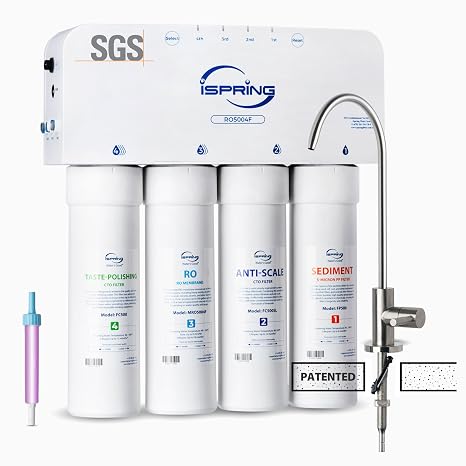
iSpring RO5004F Reverse Osmosis Water Filter with UV delivers thorough water purification suited for those who want serious contaminant removal and built-in UV protection. Its standout feature is eliminating over 99% of more than 1,000 harmful substances, including PFAS and lead, making it ideal for anyone prioritizing safe drinking water.
Installation fits neatly under the sink with a tankless design, which saves space and reduces waiting time for filtered water. Setup is straightforward, powered by a corded electric source to run the UV filter.
Replacement filters come in affordable packs lasting up to 12 months, minimizing ongoing costs and fuss when it’s time to change them out.
The system handles water purification reliably with a max flow rate of 0.35 gallons per minute and supports TDS levels up to 2000 ppm. It’s built well, focusing on safety and efficiency thanks to UV and reverse osmosis methods combined.
Users often praise its contaminant removal power, though some mention the slower flow rate as a downside in daily use.
The strongest point is the high level of contaminant removal tested independently, especially for PFAS and TDS reduction. On the downside, the water flow can feel slow due to the 0.35 gallons per minute maximum rate, which might test patience during heavy use.
People focusing on drinking water safety and willing to accept slower output will appreciate this system. Those needing faster water dispensation or wanting a non-powered setup should look for alternatives without electric components or with higher flow rates.
Pros
- Removes over 99% of 1,000+ contaminants
- Built-in UV filter for extra disinfection
- Tankless design saves under-sink space
- Replacement filters competitively priced
Cons
- Maximum flow rate is only 0.35 gpm
- Requires electrical power to operate UV filter
| Specification | Details |
|---|---|
| Maximum Flow Rate | 0.35 gpm |
| Filter Life Cycle | 12 months |
| Supported Water TDS Level Maximum (PPM) | 2000 |
| Operating Pressure Range | 30–70 psi |
| Power Source | Corded Electric |
| Container Type | Tankless |
12. Waterdrop A2 Reverse Osmosis Water Filter System

Feels convenient having hot and cold filtered water ready on the countertop. Perfect for anyone wanting clean water without the need to install under the sink. Its biggest strength lies in the precise temperature control combined with thorough filtration, offering both comfort and health.
Setup is straightforward since it sits right on the counter. Adjusting water temperature ranges from 59℉ to 203℉ easily through the smart touch screen. Favorite temperature settings can be saved so you won’t have to reset each time.
Water comes instantly filtered, so daily use feels fast and practical for drinking, cooking, or making tea.
Filtration does a solid job removing contaminants like lead, fluoride, and chlorine through a 0.0001μm RO membrane. Its build feels sturdy and modern with a dispenser-style design.
Many praise the instant hot and cold water feature, while some mention it takes up valuable counter space.
Many appreciate how quickly the system delivers both hot and cold filtered water at preferred temperatures saved by the touch screen. On the downside, the sizable countertop footprint limits space, which some find inconvenient in smaller kitchens.
Anyone wanting ready-to-drink water at varied temperatures without installation hassle will find this system helpful. Those needing a compact or hidden setup might look for a smaller unit designed for under-sink placement instead.
Pros
- Instant hot and cold water with adjustable temperatures
- Smart touch control screen with memory settings
- Reduces wide range of contaminants effectively
- Countertop design avoids complicated installation
Cons
- Occupies significant counter space
- Not suitable for under-sink installation
| Specification | Details |
|---|---|
| Filtration Stages | 5-stage Filtration |
| RO Membrane Precision | 0.0001μm |
| Temperature Range | 59 °F to 203 °F |
| Installation Type | Countertop |
| Purification Method | Reverse Osmosis |
13. Express Water 10-Stage Reverse Osmosis Filtration System

Express Water 10-Stage Reverse Osmosis Filtration System suits anyone wanting clean, purified water right from their kitchen tap. Its biggest strength lies in thorough removal of contaminants like lead and chlorine, while adding healthy minerals back with an alkaline filter for better taste.
Installation happens under the sink, making it a discreet addition to the kitchen. The 10-stage filtration means the water goes through several layers, including the RO membrane and an alkaline filter.
Day-to-day, water dispenses easily from a dedicated faucet, delivering pure and slightly mineral-enhanced water that tastes noticeably better than standard filtered water.
Performance in contaminant removal is impressive with up to 99.99% reduction in many substances. The build stands up well under regular use, with solid fittings and clear filter replacement instructions. Praised most for its water taste improvement, occasional complaints focus on the complexity of installation and routine filter changes that require care.
Water tastes significantly cleaner and better thanks to thorough filtration and mineral restoration. Most users find installation and maintenance more involved than simpler filters, which can be a hurdle without prior plumbing experience.
People seeking very pure, mineral-balanced water will appreciate what it offers. Those looking for quick, tool-free setup or minimal upkeep might want to explore other options.
Pros
- Removes up to 99.99% contaminants including lead and fluoride
- Alkaline filter adds back healthy minerals
- Under sink setup keeps countertop clutter free
- Dedicated dispenser for filtered water
Cons
- Installation can be complicated for novices
- Filter replacement requires careful attention
| Specification | Details |
|---|---|
| Purification Method | Reverse Osmosis |
| Installation Type | Under Sink |
| Container Type | Dispenser |
| Other Special Features | Reduce TDS |
14. APEC Ultimate Series Reverse Osmosis Water Filter System

Built with premium components, the APEC Ultimate Series delivers a durable reverse osmosis system perfect for anyone who wants clean, great tasting water right from their tap. Its standout feature is the high-quality filtration capable of removing a wide range of impurities to ensure ultra-fresh water daily.
Installation fits neatly under the sink and is straightforward enough to handle with basic tools. Large filters mean changing them less often, which helps avoid frequent maintenance. Using activated carbon combined with reverse osmosis tackles taste and contaminant removal effectively, so the water dispenser delivers fresh, clean water every time you draw from it.
Filtration removes over 1000 impurities including lead, fluoride, arsenic, and chlorine, meeting high water safety standards set by WQA. The large capacity filters maintain performance longer than smaller models but some users find the system takes up considerable under-sink space.
Build quality is solid, designed for reliability and long-term use with minimal issues reported overall.
The product’s strongest feature is the capability to remove nearly all impurities with filters that last longer than many alternatives. The most common downside mentioned is the amount of space it requires under the sink, which could be limiting in smaller kitchens.
Ideal for households prioritizing superior water purification and regular use without frequent filter changes. Those with limited under-sink space or on a tighter budget might consider a more compact or economical option instead.
Pros
- Removes over 1000 impurities including heavy metals
- Large filters double impurity removal capacity
- Dispenser delivers ultra-fresh, great tasting water
- Tested and approved by WQA for safety
Cons
- System occupies significant under-sink space
- Filter replacements may be costly over time
| Specification | Details |
|---|---|
| Purification Method | Activated Carbon, Reverse Osmosis |
| Installation Type | Under Sink |
| Operating Pressure Range | 85 psi |
| Lower Temperature Range | 40 °F |
| Upper Temperature Rating | 100 °F |
| Other Special Features | Reduce TDS |
15. Brio SIMPL Reverse Osmosis Water Filter System

Plenty of clean water fast is what stands out right away. It suits families or small offices looking for a reliable under-sink filtration system with a simple design.
Its biggest strength is the high output rate combined with an efficient water-to-waste ratio.
Installation is straightforward thanks to the three color-coded tubes and all the included hardware. Daily operation involves just three buttons, making it easy to get fresh water whenever needed. The tankless design keeps the system compact under the sink, and the manual, gravity-fed setup means no power connection is required.
The four-stage filtration cleans water thoroughly while protecting the membrane to maintain performance. It delivers up to 800 gallons of purified water per day at a steady flow of 2 liters per minute. The unit feels solid and leak proof, though some note the manual operation isn’t as convenient as electric models.
Filter replacements are yearly, which makes maintenance simple.
It is widely appreciated for producing a large amount of clean water quickly while minimizing wastewater. The most frequent downside mentioned is the manual, gravity-fed system which some find less convenient than powered filters but still reliable.
People who want a straightforward, high-capacity RO system without electrical requirements will be satisfied. Those seeking fully automatic or smart water filtration might prefer other models with electric operation or advanced features.
Pros
- High daily output of purified water
- Simple three-button operation
- Tankless, compact design under sink
- Leak proof build for safety
Cons
- Manual operation less convenient than electric
- Filter needs replacement every 12 months
| Specification | Details |
|---|---|
| Maximum Flow Rate | 2 liters per minute |
| Purification Method | Activated Carbon, Reverse Osmosis |
| Filter Life Cycle | 12 months |
| Power Source | Manual/Gravity-fed |
| Production Capacity | 800 GPD / 2:1 Pure to Waste Ratio |
| Installation Type | Under Sink |
Best Reverse Osmosis Water Filters Comparison Table
| Product | Capacity | Installation Type | Power Source | Special Features |
|---|---|---|---|---|
| Waterdrop G3P600 RO System | 600 GPD | Under Sink | Corded Electric | 8-stage filtration, Smart faucet |
| Bluevua RO100ROPOT Countertop | – | Countertop | Corded Electric | TDS meter, Portable |
| Waterdrop G3P800 RO System | 800 GPD | Under Sink | – | 10-stage filtration, NSF certified |
| Waterdrop X8-WAN Alkaline RO | – | Under Sink | Corded Electric | Tankless, Alkaline |
| DREO Countertop RO System | – | Countertop | – | TDS meter, Touch control |
| Waterdrop G5P500A RO Filter | 500 GPD | Under Sink | Corded Electric | 8-stage, Alkaline mineral |
| APEC ROES-50 Under Sink | – | Under Sink | AC | Activated Carbon, Reduce TDS |
| Waterdrop G6A6 Alkaline RO | – | Under Sink | – | Tankless, Alkaline |
| iSpring RCC7P-AK RO System | – | Under Sink | Corded Electric | Reduce PFAS, Alkaline |
| Philips Reverse Osmosis System | – | Under Sink | – | Tankless, Auto flushing |
| iSpring RO5004F UV Filter | 500 GPD | Under Sink | Corded Electric | UV filter, Tankless |
| Waterdrop A2 RO System | – | Countertop | – | High temp range |
| Express Water 10-Stage RO | – | Under Sink | – | 10-stage filtration |
| APEC Ultimate Series RO | – | Under Sink | – | Activated Carbon, Reduce TDS |
| Brio SIMPL RO System | – | Under Sink | Manual/Gravity-fed | Leak proof, Tankless |
- Capacity600 GPD
- Installation TypeUnder Sink
- Power SourceCorded Electric
- Special Features8-stage filtration, Smart faucet
- Capacity–
- Installation TypeCountertop
- Power SourceCorded Electric
- Special FeaturesTDS meter, Portable
- Capacity800 GPD
- Installation TypeUnder Sink
- Power Source–
- Special Features10-stage filtration, NSF certified
- Capacity–
- Installation TypeUnder Sink
- Power SourceCorded Electric
- Special FeaturesTankless, Alkaline
- Capacity–
- Installation TypeCountertop
- Power Source–
- Special FeaturesTDS meter, Touch control
- Capacity500 GPD
- Installation TypeUnder Sink
- Power SourceCorded Electric
- Special Features8-stage, Alkaline mineral
- Capacity–
- Installation TypeUnder Sink
- Power SourceAC
- Special FeaturesActivated Carbon, Reduce TDS
- Capacity–
- Installation TypeUnder Sink
- Power Source–
- Special FeaturesTankless, Alkaline
- Capacity–
- Installation TypeUnder Sink
- Power SourceCorded Electric
- Special FeaturesReduce PFAS, Alkaline
- Capacity–
- Installation TypeUnder Sink
- Power Source–
- Special FeaturesTankless, Auto flushing
- Capacity500 GPD
- Installation TypeUnder Sink
- Power SourceCorded Electric
- Special FeaturesUV filter, Tankless
- Capacity–
- Installation TypeCountertop
- Power Source–
- Special FeaturesHigh temp range
- Capacity–
- Installation TypeUnder Sink
- Power Source–
- Special Features10-stage filtration
- Capacity–
- Installation TypeUnder Sink
- Power Source–
- Special FeaturesActivated Carbon, Reduce TDS
- Capacity–
- Installation TypeUnder Sink
- Power SourceManual/Gravity-fed
- Special FeaturesLeak proof, Tankless
How to Choose the Right Reverse Osmosis Filter
Selecting a reverse osmosis filter depends on factors like filtration stages, water quality, and system capacity, which affect performance and maintenance needs. Choosing the right filter reduces waste, saves replacement costs, and ensures clean, safe water without frequent repairs or hassles.
Filtration Stages and Effectiveness
Systems with fewer than three filtration stages often fail to remove common contaminants like chlorine or lead effectively. In daily use, this means off taste, odor issues, or potential exposure to harmful substances.
A system with at least five stages typically includes sediment filters, activated carbon filters, reverse osmosis membranes, and UV or remineralization filters. This combination removes chlorine, lead, bacteria, and dissolved solids more reliably. Look for certifications such as NSF/ANSI 58 or 53, which ensure tested contaminant removal levels and safety standards.
Living with a system that meets these standards means water tastes cleaner and feels safer to drink without worrying about harmful chemicals. Without proper filtration, tap water might carry unpleasant tastes or pose health risks, especially in older plumbing areas.
Water Waste Ratio and Efficiency
Many reverse osmosis setups waste about 3 to 4 gallons for every gallon of purified water produced, which quickly affects water bills and overall efficiency. A system with a water waste ratio closer to 1:1 or 2:1 significantly reduces this loss. Storage tanks generally range between 2 to 4 gallons, affecting how much purified water is available without waiting for more to be processed.
A faster water flow rate, around 50 to 75 gallons per day, means less waiting at the tap. Systems with low efficiency cause higher water bills and frequent tank refills, which can be a nuisance during busy times. Choosing a product with good efficiency is important to manage both cost and convenience.
Installation and Space Requirements
Most units fit under a standard kitchen sink, but some components like large storage tanks require at least 12 to 15 inches of vertical clearance. Models with compact tanks and slim filter housings are easier to install in tight spaces.
Installation complexity varies; some come with user-friendly instructions suitable for basic DIY skills, while others need professional plumbing help to ensure leak-free connections.
Compatibility with your existing plumbing can’t be ignored. Many systems connect to standard 1/4 inch tubing and common faucet types, but adapters may be necessary for older or unusual plumbing setups. Taking exact measurements of available cabinet space before choosing a system prevents surprises during installation.
Maintenance and Filter Replacement
Filter replacements usually occur every 6 to 12 months, depending largely on water quality and usage. Costs vary between $50 and $150 for a full set of filters annually.
Units designed with easy-release cartridges or quick-connect fittings save time and avoid the frustration of fiddly tools or tight spaces during replacement.
Having filters easily accessible under the sink means maintenance doesn’t feel like a chore, encouraging timely changes that keep water quality high. Check that replacement filters are widely available and specific to the model; generic alternatives sometimes fail to fit properly or compromise filtration effectiveness.
Build Quality and Materials
Systems built from stainless steel or heavy-duty plastic resist corrosion better than cheaper metal parts, lasting longer without leaks or cracks. Using food-grade, BPA-free materials for all water contact surfaces prevents unwanted tastes or odors from developing over time.
In practice, poor material quality often results in plastic or metallic off-flavors, which reduce enjoyment and can make drinking sufficient water harder. Investing in a system with high-quality components means cleaner-tasting water and less frequent repairs.
Optimizing Reverse Osmosis Water Filters for Maximum Efficiency
Reverse osmosis (RO) water filters perform best when the water pressure is within the ideal range, usually between 40 and 80 psi. Lower pressure can slow the filtration process and reduce water output, while pressure that is too high might damage the membrane. Most systems include a pressure gauge in the setup, which helps to monitor this.
Temperature also affects efficiency. Water that is too cold passes through the RO membrane more slowly, so avoiding very cold water sources can improve flow rates.
To optimize performance:
- Check the pre-filters regularly to ensure they are not clogged, as this increases strain on the membrane.
- Maintain proper water pressure with a booster pump if necessary.
- Replace membranes on schedule as recommended by the manufacturer to keep filtration at peak levels.
By focusing on these points, the filter can remove contaminants effectively without wasting water or requiring frequent repairs.
Common Maintenance Practices to Prolong Filter Life
Regular maintenance is essential to keep reverse osmosis filters functioning properly and to extend the lifespan of the components. The pre-filters, including sediment and carbon filters, generally require replacement every 6 to 12 months. These filters capture larger particles and chlorine, which can damage the RO membrane if allowed to accumulate.
The membrane itself should be checked and replaced approximately every 2 to 3 years, depending on water quality and usage. Some systems have indicators to signal when it’s time for replacement.
Practical maintenance steps:
- Flush the system periodically to remove trapped contaminants.
- Clean the storage tank annually to prevent bacterial buildup.
- Inspect fittings and tubing for leaks or damage during filter changes.
Following these guidelines ensures the filter delivers clean water consistently and reduces the chance of costly repairs.
Comparing Reverse Osmosis Systems with Other Water Purification Methods
Reverse osmosis systems remove a broad range of impurities by forcing water through a semipermeable membrane. This process removes dissolved salts, heavy metals, and many organic substances, which sets RO apart from simpler filtration methods.
Compared to carbon filters, RO units target smaller contaminants like fluoride and nitrates, which activated carbon cannot effectively remove. UV purifiers kill bacteria and viruses but don’t remove dissolved solids or chemicals.
Distillation removes most contaminants by boiling and condensing water but uses more energy and takes longer.
Comparing key points:
- RO systems often produce purified water with a noticeable drop in mineral content, which some users prefer.
- They generally require more maintenance and produce wastewater that must be considered.
- Other methods may be simpler and cheaper but usually don’t match the comprehensive contaminant removal of an RO system.
The choice depends on water quality concerns, budget, and maintenance willingness.
People Also Asked
How Do I Maintain and Clean a Reverse Osmosis Water Filter?
Regular maintenance involves changing pre-filters every six to twelve months and the RO membrane every two to three years, depending on water quality. Periodically sanitizing the system helps prevent bacterial buildup and ensures clean taste. Keeping an eye on water pressure also helps maintain system efficiency.
What Size Reverse Osmosis System Do I Need for My Household?
A 50 to 75 gallons per day RO system fits most families of four comfortably. This capacity supports typical daily water needs without running out or causing slow flow. Consider household size and daily water consumption when choosing to avoid undersized systems.
Are Reverse Osmosis Filters Safe for Drinking Water Daily?
Reverse osmosis water is safe for daily drinking as it removes most contaminants and impurities. Some systems reduce beneficial minerals, which can be supplemented via diet or mineral filters added to the system. Regular filter changes keep the water safe and fresh tasting.
How Long Does a Reverse Osmosis Water Filter Typically Last?
The membrane in an RO system typically lasts two to three years, while sediment and carbon filters need replacement every six to twelve months. These timelines vary based on water hardness and usage. Monitoring water taste and flow can indicate when filters need replacement.
What Common Problems Occur with Reverse Osmosis Water Filters?
Common issues include low water pressure, slow water flow, and mineral buildup on the membrane. Leaks around fittings and tanks can also occur. Regular filter changes and system flushing help prevent these problems and keep water quality consistent.
Conclusion
Choosing the right reverse osmosis water filter depends mainly on the quality of filtration, ease of installation, and filter replacement costs. Consider how well the system removes contaminants you’re concerned about and whether the filters are readily available. Also, think about the size and footprint of the unit since space under the sink can be limited.
Make sure the system fits your budget and how often you plan to change the filters, as these factors affect long-term use. Check the comparison table and detailed picks above to see which system matches your needs and space. Taking time to review these points will help you find a water filter that works well for your home.