How to Measure Kitchen Cabinet Doors: A Step-by-Step Guide
Many homeowners find measuring kitchen cabinet doors to be a tricky task, especially if you’re new to DIY projects. You’re not alone—accurately measuring is essential for a perfect fit, but it can feel overwhelming at first. Don’t worry, though; with a few simple steps, you’ll be able to get it right every time.
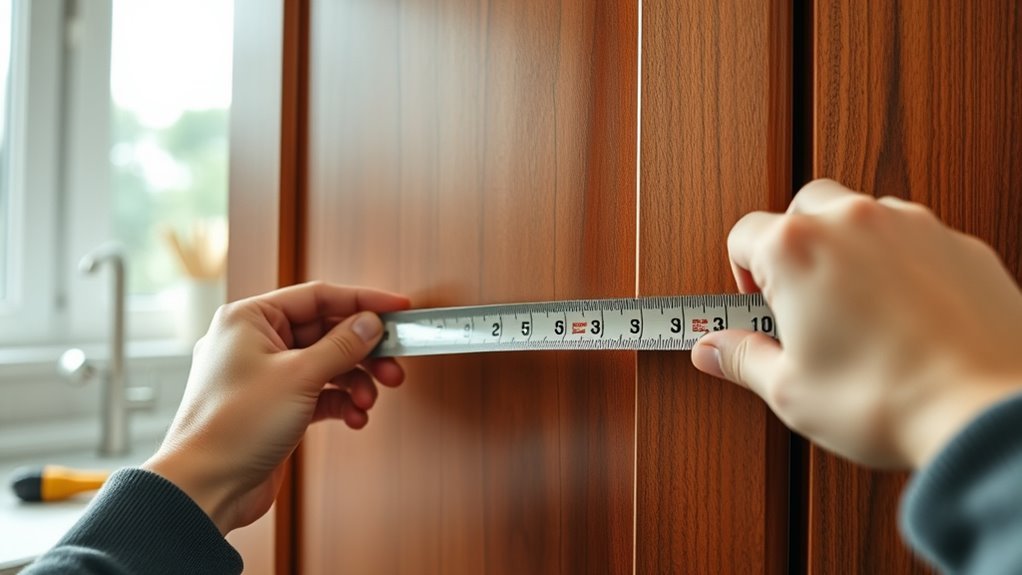
To measure your kitchen cabinet doors accurately, start by using a reliable tape measure to record the height from bottom to top and the width at the widest point, excluding hardware. Use a caliper or ruler to check door thickness and note edge details.
Measure hinge and handle positions carefully for perfect placement. Be sure to measure each door individually and double-check your numbers to avoid errors.
Keep these basics in mind, and you’ll gain insights for smooth replacements or refacing.
Key Takeaways
- Use a steel tape measure to record the height from the bottom to the top edge of each cabinet door.
- Measure the door width at its widest point, excluding hardware, to ensure a proper fit.
- Use a caliper or ruler to check the door thickness and note any edge profiles or decorative details.
- Measure hinge positions from the top and bottom edges to the center of the hinge for accurate hardware placement.
- Record all measurements carefully, double-checking for accuracy, and round down to the nearest 1/16 inch.
Tools Needed to Measure Cabinet Doors
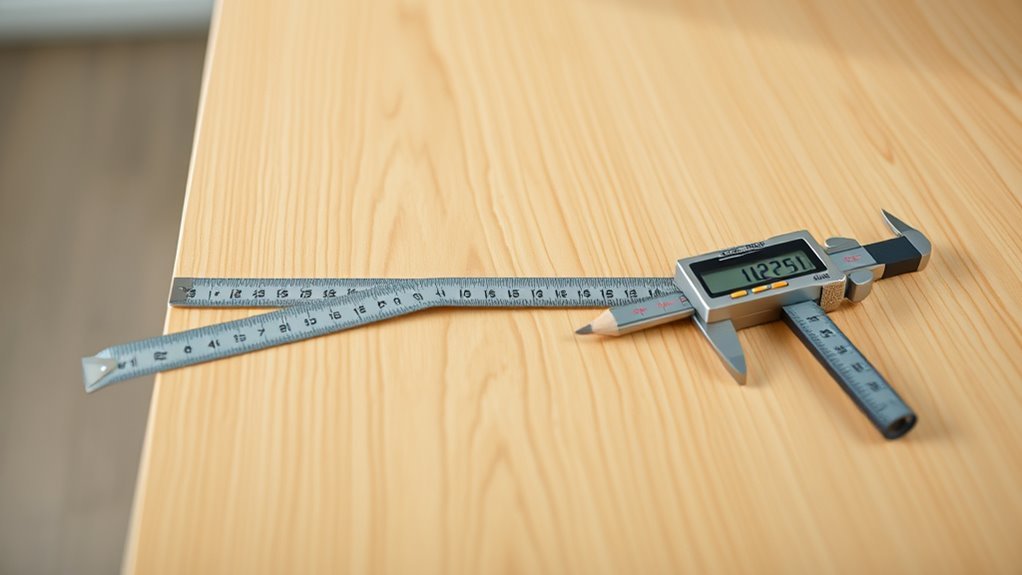
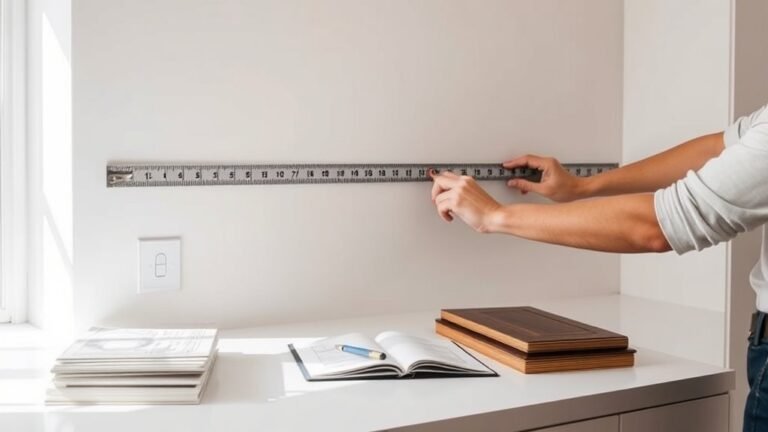
To measure your kitchen cabinet doors accurately, you’ll need a few essential tools. Start with a reliable tape measure—this is your primary tool for getting precise dimensions. A steel tape measure works best because it stays straight and won’t stretch.
Accurate cabinet door measurements start with a reliable steel tape measure for precise, consistent dimensions.
You’ll also want a notepad and pencil to jot down your measurements clearly. A level can be handy to guarantee your measurements are straight, especially if your cabinets aren’t perfectly aligned.
For more detailed measurement techniques, consider using a caliper for thickness or a ruler for smaller, intricate parts. Avoid guessing or eyeballing; precise tools help prevent costly errors when ordering new doors or replacements.
Having these essential tools on hand lets you follow measurement techniques confidently and efficiently. With the right gear, you’ll capture exact width and depth dimensions, setting you up for smooth progress in your cabinet project.
Measure the Height of Your Cabinet Doors
Measuring the height of your cabinet doors starts with placing the tape measure at the bottom edge and extending it straight up to the top edge. Make sure the tape is taut and vertical to get an accurate door height.
Hold the tape steady and note the measurement where it meets the top edge. This is your door height.
Use precise measurement techniques, like reading directly from the tape’s markings without guessing between increments. If your doors have molding or raised panels, measure the full height of the door itself, not just the flat surface.
Repeat this process for each door since sizes can vary slightly due to installation or design differences. Record each door height carefully to avoid confusion later.
Measure the Width of Your Cabinet Doors
After you’ve accurately noted the height of each cabinet door, the next step is to determine their width. Use a tape measure to get the exact width from one edge of the door to the other, measuring at the widest point. Be sure to measure each door individually, especially if your kitchen has different-sized cabinet doors.
Precise measurements are essential because cabinet door materials can expand or contract slightly with humidity and temperature. Double-check your figures to ensure accuracy.
Keep in mind your door hardware options, like handles or knobs, as their placement might affect how you measure the width if hardware protrudes beyond the door edges. Don’t include the hardware’s size in your width measurement—focus only on the door itself.
Accurate width measurements guarantee your replacement or custom cabinet doors fit perfectly. They will also complement your kitchen’s overall design and functionality.
Measure Thickness and Edge Details of Cabinet Doors
Next up, you’ll want to get an accurate measurement of your cabinet doors’ thickness. Grab a caliper or a ruler—whichever you’re more comfortable with—and carefully measure along the edge.
Don’t forget to pay close attention to the edge profiles too. Those little details can really influence how well the doors fit and the overall style you’re aiming for. Using the right tools for these measurements will make sure you capture all the details precisely, helping you achieve that perfect match.
Thickness Measurement Techniques
Although it might seem straightforward, getting an accurate thickness measurement of your kitchen cabinet doors is really important for a proper fit and finish. Small variations in thickness can affect how the doors close and align smoothly.
Use precise measuring tools like calipers or a ruler, and check multiple points to catch any inconsistencies. This way, you ensure your measurements are accurate across the entire door.
Here’s a quick guide on thickness measurement tools and tips:
| Tool | Accuracy | Tip |
|---|---|---|
| Caliper | ±0.01 mm | Measure at several points |
| Tape Measure | ±1 mm | Make sure it’s flush with the edge |
| Ruler | ±1 mm | Use for rough estimates |
| Thickness Gauge | ±0.05 mm | Best for fine variations |
| Micrometer | ±0.001 mm | Perfect for precise readings |
Using the right tools and tips will help you get consistent, accurate measurements every time.
Identifying Edge Profiles
When measuring your kitchen cabinet doors, paying attention to the edge profiles is just as important as checking thickness. Edge profiles influence both the look of your doors and how well they fit with your kitchen’s style. So, identifying the right edge profile types is key to keeping your design impactful.
Here’s what to focus on:
- Check if the edges are rounded, beveled, or square.
- Look for any decorative grooves or detailed designs.
- See if the edge transitions smoothly or has sharp lines.
- Make sure the profile matches your overall kitchen style.
- Note any unique edge features that could affect measurement or replacement.
Tools for Accurate Measurement
Accurate measurement starts with having the right tools at hand. To measure the thickness and edge details of your cabinet doors, you’ll need precise measuring tools like a caliper or a digital micrometer. These tools help you capture exact dimensions, ensuring measurement accuracy vital for fitting or replacement.
A ruler or tape measure won’t cut it when you need to gauge thickness or intricate edges. Use a caliper to measure the door’s thickness down to fractions of an inch or millimeters. For edge profiles, a contour gauge can replicate shapes accurately, helping you note curves or bevels.
Measure Hinge and Handle Positions on Cabinet Doors
Start by identifying the exact locations of the hinges and handles on your cabinet doors. Knowing the hinge types and handle styles helps you measure accurately and plan replacements or upgrades. Here’s how to measure hinge and handle positions efficiently:
Note the hinge type, like concealed or surface-mounted, so you understand the mounting points. Then, measure from the top and bottom edges of the door to the hinge center.
For handles, first identify the style, whether it’s a knob, pull, or bar. Measure the distance between screw holes or from the door edge to the handle center.
Record the handle height from the bottom or top edge for consistent placement. These measurements ensure your new doors fit perfectly and the hardware lines up well.
Taking precise hinge and handle measurements helps prevent installation headaches later on.
Record and Double-Check Your Cabinet Door Measurements
To make sure your cabinet doors fit perfectly, carefully record every measurement and double-check each one before moving on. Write down each dimension clearly, using consistent units like inches or centimeters to keep everything accurate. Use reliable methods like a dedicated notebook or digital spreadsheet, and label each entry by cabinet location and feature, like height, width, or hinge position.
Once you’ve got all your measurements down, go back and measure each door again to confirm your numbers. This helps catch any mistakes or inconsistencies, so you avoid costly errors later. If you can, ask someone else to review your measurements for a fresh perspective. Accurate recording and thorough double-checking will give you confidence that your cabinet doors will fit smoothly. This saves time and frustration during installation. Don’t rush this step—it’s key to a seamless kitchen upgrade.
Identify Your Cabinet Door Type
Before you start measuring, it’s a good idea to figure out what kind of cabinet door you have. This way, you’ll make sure everything fits perfectly. Most cabinet doors are pretty standard and fall into categories like shaker, raised panel, or flat panel. They can also be either framed or slab designs.
Knowing your door type is really helpful because it ensures you get the right size, fit, and finish for your kitchen. It’s like checking the recipe before you start cooking — a little prep work goes a long way!
Common Cabinet Door Styles
Although kitchen cabinet doors come in many designs, recognizing your cabinet door style is key for accurate measurement and replacement. Knowing your cabinet styles and door materials helps you pick the right size and ensures a perfect fit.
Here are some common cabinet door styles you’ll find:
- Shaker: Simple, clean lines with a recessed center panel.
- Raised Panel: Features a center panel that’s raised, adding depth.
- Flat Panel (Slab): Smooth, flat surface without detailing.
- Beadboard: Vertical grooves for a textured look.
- Glass-Front: Doors with glass inserts to showcase contents.
Identifying your door style makes it easier to measure correctly and choose replacements that blend seamlessly with your kitchen’s look.
Frame vs. Slab Doors
Understanding whether your cabinet doors are frame or slab types helps you measure them accurately and choose the right replacements.
Frame construction doors have a visible border around the panel, giving a classic look and added support. Slab doors are flat and featureless, offering a sleek, modern feel and easy cleaning.
Knowing your door type guides your measuring approach and replacement options.
| Feature | Frame Doors |
|---|---|
| Construction | Frame construction with panels |
| Style | Traditional, detailed |
| Durability | High due to sturdy frame |
| Measuring Tip | Measure panel and frame separately |
| Feature | Slab Doors |
| Construction | Flat, one-piece |
| Style | Modern, minimalist |
| Durability | Moderate |
| Measuring Tip | Measure full door surface |
Use this info to measure correctly and pick replacements that highlight slab’s sleek look or frame’s strength.
Measure Overlay, Inset, and Partial Overlay Doors
Three common types of cabinet door styles—overlay, inset, and partial overlay—each need different measuring techniques to get a perfect fit.
When measuring overlay door styles, measure the door’s width and height as it covers the cabinet frame fully or partially. Inset door advantages include a sleek, flush look, so you’ll measure the exact cabinet opening since the door sits inside the frame.
Measure overlay doors by their full coverage; inset doors require exact cabinet opening dimensions for a flush fit.
Here’s how to measure each style:
- For full overlay doors, measure the full width and height covering the cabinet frame.
- For inset doors, measure the cabinet opening width and height exactly.
- For partial overlay doors, measure the door’s exposed width and height.
- Check for any gaps between doors and frames for accuracy.
- Always measure in multiple spots to confirm consistency.
Measuring Tips for Door Replacement and Refacing
When you’re replacing or refacing cabinet doors, it’s really important to measure the width and height accurately. This way, you can be sure everything will fit just right. Don’t forget to double-check the door thickness too, since that can affect which hinges you’ll need.
And while you’re at it, take your time measuring where the hinges will go. Getting that placement right from the start can save you a lot of hassle during installation.
Accurate Width And Height
Measuring the width and height of your kitchen cabinet doors accurately is key for a perfect replacement or refacing project. Precise measurements ensure your new doors fit well and match your kitchen style.
Use a steel tape measure for the best accuracy. Measure each door one by one because sizes can differ. Focus on the widest and tallest points, ignoring hinges.
Record your measurements in inches, rounding down to the nearest 1/16 inch. Before placing an order, double-check your numbers to avoid any mistakes.
Checking Door Thickness
Although width and height are important, don’t forget to check the door thickness when replacing or refacing. Thickness varies depending on the material and can affect how you install the door. Measuring it accurately ensures a perfect fit.
Use a caliper or ruler to check the edge of the door at several points. This helps you confirm consistency and avoids surprises during installation.
| Door Material | Typical Thickness | Installation Consideration |
|---|---|---|
| Solid Wood | 3/4 inch | May need sturdier hinges |
| MDF (Medium-Density Fiberboard) | 5/8 inch | Lighter and easier to handle |
| Plywood | 1/2 to 3/4 inch | Check for warping before fitting |
Measuring thickness helps you avoid issues during installation and makes sure your new doors line up well with existing cabinetry.
Measuring Hinge Placement
Since hinge placement directly affects how your cabinet doors open and close, getting these measurements right is essential for a smooth installation. Start by noting the hinge types on your current doors because different hinges need precise positioning. Next, measure the hinge spacing—the distance between the top and bottom hinges—to make sure your new doors fit perfectly.
Here’s how to measure hinge placement accurately:
- Identify the hinge type, like concealed or surface-mounted.
- Measure from the top edge of the door to the center of the top hinge.
- Measure from the bottom edge to the center of the bottom hinge.
- Note the spacing between hinges along the door’s edge.
- Double-check your measurements for consistency across all doors.
Following these steps helps you avoid alignment issues during replacement or refacing.
Avoid Common Mistakes When Measuring Cabinet Doors
When measuring cabinet doors, small mistakes can lead to costly replacements or doors that don’t fit right. To avoid these issues, double-check your measurements and use the right tools.
Measuring errors often happen when you forget to account for the door’s thickness or misread your tape measure. Always measure twice and write down your results clearly.
Here’s a quick guide to help you avoid common mistakes:
| Mistake | Cause | How to Avoid |
|---|---|---|
| Incorrect width | Measuring outside frame edges | Measure only the actual door panel |
| Ignoring thickness | Forgetting door depth | Use a caliper or ruler for accuracy |
| Skipping hinge area | Overlooking hinge placement | Measure hinge locations separately |
| Rushing | Lack of patience | Take your time and double-check |
| Poor tools | Worn-out tape measure | Use a reliable, calibrated tape |
Frequently Asked Questions
How Do I Choose the Right Material for New Cabinet Doors?
You choose the right cabinet door material by weighing your options against durability considerations. Think about how much wear and tear your kitchen sees daily.
Solid wood offers classic durability but can be pricey. MDF is budget-friendly and smooth but less sturdy. Thermofoil resists moisture well, making it great for humid kitchens.
Consider your style, budget, and how long you want the doors to last before making a decision.
Can I Paint My Cabinet Doors Instead of Replacing Them?
Absolutely, you can paint your cabinet doors instead of replacing them. But there’s a catch. To get a smooth, lasting finish, you’ll need to focus on paint preparation.
That means cleaning, sanding, and repairing any damage first. Next, don’t skip surface priming; it’s essential for adhesion and durability.
With the right prep and primer, your cabinets will look refreshed and stylish without the cost or hassle of full replacement.
What Is the Average Cost of Custom Kitchen Cabinet Doors?
You can expect custom door pricing to range from $100 to $500 per door, depending on materials, design, and craftsmanship.
Installation factors like cabinet size, door style, and labor costs also impact the total price.
If you want high-quality, personalized doors, be prepared to invest more. Getting multiple quotes helps you compare prices and find the best deal that fits your budget and style preferences.
How Long Does It Take to Install New Cabinet Doors?
You can expect the installation of new cabinet doors to take about 1 to 3 hours, depending on how many doors you’re working with and your experience level.
You’ll need basic tools like a screwdriver, drill, level, and measuring tape to get the job done efficiently. Taking your time to align hinges and handles properly will help you avoid mistakes.
Proper alignment ensures everything fits perfectly, which can actually speed up the process overall. So, don’t rush—precision makes a big difference.
Are There Eco-Friendly Options for Kitchen Cabinet Doors?
Yes, you’ll find plenty of eco-friendly options for kitchen cabinet doors! In fact, about 60% of homeowners now prefer sustainable materials like bamboo or reclaimed wood.
These options not only reduce environmental impact but also look stunning. Plus, you can choose eco-friendly finishes, such as water-based or natural oils, that avoid harmful chemicals.
Conclusion
Measuring your kitchen cabinet doors is like laying the foundation for a sturdy house. It sets everything in place for a perfect fit.
By following each step carefully and double-checking your measurements, you’ll avoid costly mistakes. This way, your new doors will look flawless.
Keep your tools handy, stay precise, and remember—taking your time now saves you frustration later.
With these tips, you’re ready to transform your kitchen with confidence. Properly measuring your kitchen cabinet doors ensures a seamless update and a beautiful finish.