Microwave Exhaust Fan Over Range Guide: What to Know Before You Buy
Are you tired of lingering cooking odors and smoky air filling your kitchen? You’re not alone—many people struggle to find the right microwave exhaust fan over their range that balances power, noise, and ease of use.
The good news is, with a little guidance, you can choose the perfect fit for your space and habits.
When choosing a microwave exhaust fan over your range, consider your kitchen size and cooking habits to pick the right CFM for effective ventilation.
Decide between ducted fans that vent outside for better air quality or ductless models with charcoal filters that recirculate air but need frequent upkeep.
Check noise levels, installation space, and user-friendly features like adjustable speeds.
Proper maintenance keeps your fan efficient and safe.
Keep exploring to uncover installation tips and avoid common purchase mistakes.
Key Takeaways
- Decide between ducted fans that vent outside or ductless fans with charcoal filters, based on your kitchen layout and ventilation needs.
- Match the fan’s CFM rating to your kitchen size and how much you cook to make sure smoke and odors are effectively removed without creating too much noise.
- Measure your space carefully and check mounting options. Consider hiring a professional to ensure proper alignment and electrical safety.
- Look at decibel ratings and choose insulated models to keep motor noise, vibrations, and rattling from loose filters to a minimum.
- Choose controls that are easy to use, and prioritize energy efficiency and simple maintenance. Regularly clean or replace filters to keep airflow and performance steady.
How a Microwave Exhaust Fan Works Over Your Range
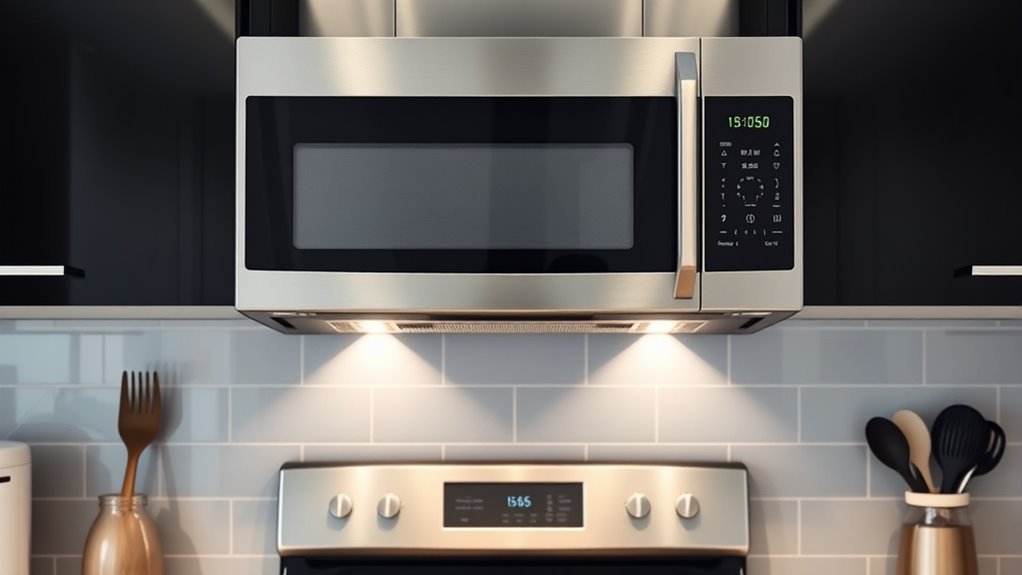
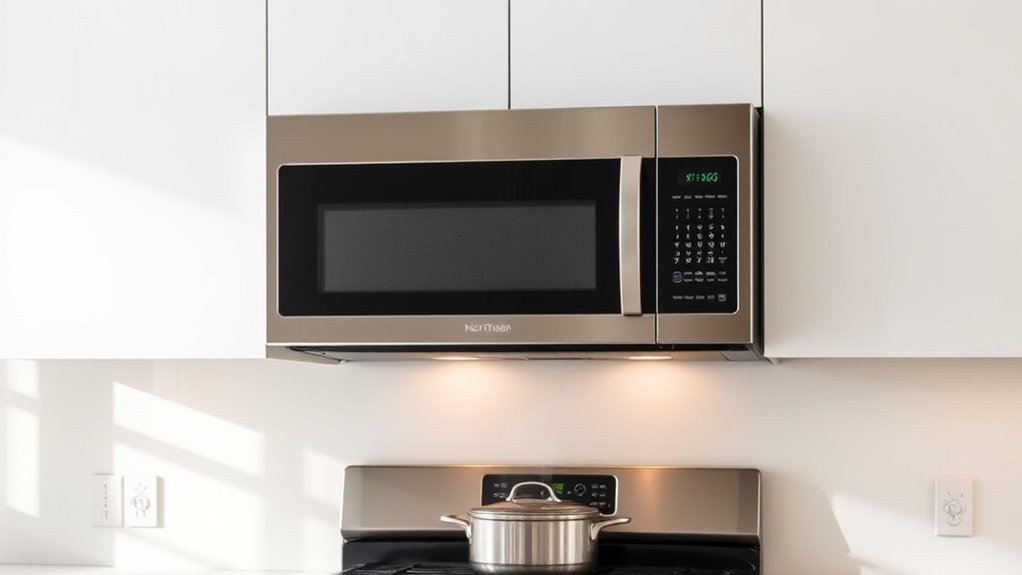
Although you might not notice it at first, the microwave exhaust fan is essential for keeping your kitchen air clean while you cook. It pulls smoke, steam, and odors from your stovetop, venting them outside or filtering and recirculating the air back into your kitchen.
Understanding the different fan types helps you pick the right one. Ducted fans expel air outdoors, while ductless fans use charcoal filters to clean and recycle the air inside.
Knowing whether your fan vents outside or recycles air with filters helps you choose the best option.
For installation, position the fan directly above your range for maximum efficiency. Make sure the vent connects properly to your ductwork or that the filters are easy to access for quick replacement if you have a ductless system.
Also, check the fan’s noise level and airflow capacity to match your cooking habits. With the right type and proper setup, your microwave exhaust fan will keep your kitchen air fresh without interrupting your cooking flow.
Choosing the Right Size Microwave Exhaust Fan for Your Kitchen
First things first, you’ll want to measure your kitchen’s ventilation needs. Think about the size of your space and how much you cook — those habits really matter. Once you have a good idea of that, you can pick a microwave exhaust fan with the right capacity.
Choosing the right size is key because it helps you get rid of smoke and odors effectively. Plus, it keeps your kitchen fresh without wasting energy. So, taking a little time to match the fan’s size to your kitchen’s needs is totally worth it!
Measuring Kitchen Ventilation Needs
How do you determine the right size microwave exhaust fan for your kitchen? Start by evaluating your kitchen layout. Open-concept kitchens might need more powerful ventilation than enclosed spaces.
Next, consider the types of ventilation available. Ducted systems vent air outside, while ductless recirculate filtered air back into the room. Each type influences how much airflow you’ll need.
Measure your cooking area’s dimensions carefully, paying special attention to the stove or cooktop. That’s where most steam and odors come from.
Also, think about your cooking habits. If you do a lot of frying or grilling, you’ll need better ventilation.
Matching Fan Capacity
Understanding your kitchen’s ventilation needs helps you choose the right microwave exhaust fan capacity. Think about your kitchen size and how often you cook. A fan that’s too small won’t get rid of smoke or odors well, while a bigger one might be noisy and waste energy.
Make sure the fan works with your microwave model for easy setup. Check the fan’s cubic feet per minute (CFM) rating, which shows how much air it moves. Kitchens with heavy cooking need higher CFM fans.
When installing, follow the manufacturer’s tips carefully to ensure proper venting. Doing so will prevent performance issues. Matching the fan capacity to your needs improves air quality and keeps your kitchen comfortable and safe.
Understanding Airflow (CFM) Ratings and What You Need
You want to get a handle on what CFM ratings really mean because they tell you how much air a fan can move each minute. It’s pretty important when you’re trying to pick the right fan for your space. If the CFM matches your kitchen size, it’ll do a good job at ventilating without using up too much energy.
Basically, knowing about CFM helps you choose a fan that keeps your kitchen fresh and free from smoke and cooking odors. It’s all about finding that sweet spot where your fan works efficiently and keeps the air clean.
CFM Measurement Basics
Although choosing the right microwave exhaust fan might seem straightforward, understanding what CFM ratings mean is key to making a good choice.
CFM stands for “cubic feet per minute,” which shows how much air the fan moves in one minute.
That number tells you how powerful and efficient the fan is at clearing smoke, steam, and odors.
Knowing how to calculate CFM helps you see if a fan will meet your kitchen’s ventilation needs.
Manufacturers consider factors like kitchen size and cooking habits when choosing the right CFM.
Focusing on these basics helps you avoid overspending on too-powerful models or settling for fans that can’t handle your cooking.
Matching CFM To Kitchen Size
Knowing how CFM reflects a fan’s airflow capacity helps you match the right exhaust fan to your kitchen size. Your kitchen layout and fan placement are key factors in determining the needed CFM.
Larger kitchens or open layouts need fans with higher CFM to effectively clear smoke and odors. When choosing, consider the room’s volume and how much you cook regularly.
| Kitchen Size | Recommended CFM | Notes |
|---|---|---|
| Small (under 100 sq ft) | 100-200 | Compact layouts, minimal cooking |
| Medium (100-200 sq ft) | 200-350 | Average kitchen, moderate cooking |
| Large (200+ sq ft) | 350+ | Open layouts, heavy cooking |
Choose a fan with the right CFM to ensure proper ventilation without overworking the unit or wasting energy.
Impact Of CFM On Ventilation
Since CFM measures how much air a fan moves per minute, it directly influences how well your kitchen stays ventilated. You want a microwave exhaust fan with the right CFM to handle cooking fumes and odors efficiently.
If the CFM is too low, stale air tends to stick around, making the space less comfortable. On the other hand, a CFM that’s too high wastes energy by creating unnecessary airflow.
Understanding airflow dynamics helps you see how the fan moves air through ducts and filters, affecting overall performance. Fan efficiency also matters; a high-CFM fan isn’t always better if it struggles against resistance or uses too much power.
Comparing Venting Options: Ducted vs. Ductless Microwave Exhaust Fans
Anyone shopping for a microwave exhaust fan will need to decide between ducted and ductless venting options. Ducted benefits include effectively removing smoke, odors, and moisture by venting air outside your home. This helps keep your indoor air quality better and reduces humidity in your kitchen.
Ducted systems also tend to be quieter since they push air outdoors rather than recirculating it inside. On the other hand, ductless fans recycle air through charcoal filters, which trap odors but don’t eliminate moisture or heat.
The drawbacks of ductless models include less effective ventilation and the need for frequent filter changes to keep them working well. While they’re easier to install and work fine in spaces without external venting, they can leave your kitchen feeling stuffy during heavy cooking.
Ultimately, it’s about weighing the benefits of ducted options against the drawbacks of ductless models. This will help you pick the exhaust fan that best fits your kitchen’s layout and ventilation needs.
Installation Options and Requirements for Over-the-Range Fans
When installing an over-the-range microwave exhaust fan, you’ll need to assess both the space available and how your kitchen is vented. Installation challenges often come from limited clearance between the microwave and the cooktop or cabinets.
Before you start, measure the height, width, and depth to ensure your new unit fits properly. Check if your kitchen supports ducted or ductless venting, as this influences your mounting options.
Most over-the-range fans have two main mounting options: wall mount and cabinet mount. Wall mounting requires sturdy wall studs for a secure fit, while cabinet mounting depends on the strength of the cabinets above the stove.
Both methods need proper alignment for effective venting and safety. Keep in mind, electrical hookups and vent connections can be tricky, so be ready for some installation challenges or consider hiring a professional.
Proper installation ensures your microwave fan works safely and efficiently.
Microwave Exhaust Fan Noise Levels and How to Minimize Sound
You’ll probably notice that microwave exhaust fans can be pretty different when it comes to noise levels. Knowing about decibel ratings can actually help you pick a quieter model if that’s important to you. The main sources of noise are usually the motor and the airflow, and they can get quite loud when the fan is running.
If you want to keep the noise down, there are some simple things you can do. Regularly cleaning the fan can make a difference, and choosing models with better insulation can also help reduce the sound. It’s all about those little tweaks to make your kitchen a bit quieter!
Common Noise Sources
Although microwave exhaust fans are essential for removing odors and steam, their noise can become a nuisance in your kitchen. Understanding common noise sources helps you tackle sound issues effectively. Here are the usual culprits:
Fan vibrations and motor hums happen when the fan motor isn’t balanced or wears out, causing persistent buzzing or humming.
Filter rattling and installation echoes occur when filters are loose or installed improperly, creating rattling sounds and amplifying noises through structural resonance.
Airflow turbulence and duct noise happen when air moves unevenly or through narrow ducts, generating whooshing or rattling sounds.
Fan speed settings influence noise levels—higher speeds increase noise, so adjusting them can help reduce sound without sacrificing performance.
Decibel Ratings Explained
Since noise levels can really impact your kitchen comfort, understanding decibel ratings for microwave exhaust fans helps you pick quieter models and manage sound better. Decibel scales measure sound intensity, but keep in mind, the scale isn’t linear—an increase of 10 decibels makes the sound seem roughly twice as loud.
So, a fan rated at 60 dB sounds much louder than one at 50 dB. Your perception of sound also varies depending on background noise and room acoustics, which can make some fans seem louder even if their decibel levels are similar.
When comparing models, check their decibel ratings at different fan speeds to get a better idea of real-world noise. By understanding these ratings and how you perceive sound, you’ll find a microwave exhaust fan that fits your kitchen’s noise comfort level perfectly.
Sound Reduction Tips
When aiming to reduce microwave exhaust fan noise, you can take several practical steps to create a quieter kitchen environment. Proper fan placement plays an essential role in minimizing sound transmission. Position the fan away from walls or cabinets that could amplify noise.
Adding sound insulation around the exhaust duct can greatly dampen vibrations and reduce overall noise. Also, regularly clean and maintain the fan to prevent rattling or excessive noise from debris buildup.
Finally, consider choosing models designed with noise reduction features for quieter operation. These tips help you enjoy cooking without the distraction of loud fan noise.
Controls and Features That Make Cooking Easier
If you want to make cooking easier, choosing a microwave exhaust fan with intuitive controls and smart features can really help. Look for models with user-friendly options like touch controls and simple settings that let you adjust fan speeds and lighting easily.
Programmable timers are great because you can set the exhaust fan to run just as long as you need, so you don’t have to keep checking on it. Adjustable speeds give you flexibility depending on what you’re cooking.
Programmable timers and adjustable speeds let you customize fan operation for hassle-free cooking control.
Integrated lighting brightens your stovetop, making it easier to see what you’re doing. Remote operation is convenient too—you can control the fan without interrupting your workflow.
Safety locks are a smart feature, ensuring the fan won’t turn on or off accidentally, giving you peace of mind. Plus, easy-to-clean designs help you maintain your microwave exhaust fan with minimal effort, keeping it working efficiently and looking good.
Focusing on these features means you’ll enjoy a smoother, more efficient cooking routine.
Energy Efficiency and Maintenance Tips for Long-Lasting Fans
Although a microwave exhaust fan might seem small, choosing an energy-efficient model and keeping it maintained can save you money and help it last longer. Look for high energy ratings when shopping to ensure it uses less power but still works well. Proper care also makes your fan more durable, so it runs smoothly for years.
To keep your exhaust fan energy-efficient and long-lasting, follow these simple tips:
- Regularly clean or replace filters to prevent buildup that can strain the motor.
- Wipe down fan blades and vents to keep airflow steady and reduce energy use.
- Check periodically for signs of wear or loose parts that could affect performance.
- Use the fan only when needed and pick the right speed settings to save energy.
Common Mistakes to Avoid When Selecting Your Microwave Exhaust Fan
Because selecting the right microwave exhaust fan affects both your kitchen’s air quality and energy use, you’ll want to avoid common pitfalls. First, don’t overlook important design considerations like the fan’s size and airflow capacity. Choosing a unit that’s too small won’t effectively remove odors or smoke.
Also, ignoring the noise level can make your cooking environment unpleasant. Second, skipping proper installation tips can cause problems. Make sure you measure your space carefully and follow manufacturer guidelines to prevent poor ventilation or electrical issues.
Avoid assuming all fans vent the same way. Confirm whether your kitchen supports ducted or ductless setups and pick accordingly. Finally, don’t forget to check maintenance requirements; a fan that’s hard to clean may not last as long.
Top Brands and Models of Microwave Exhaust Fans to Consider
Choosing the right microwave exhaust fan means knowing which brands and models deliver reliable performance and fit your kitchen’s needs. To make an informed decision, look at top brands known for durability and efficiency. Comparing models and reading consumer reviews can help you find fans with the best performance ratings and warranty options.
Don’t forget to consider your budget and the style of your kitchen. You want a fan that looks good and fits your space without overspending. Installation tips are also important to ensure the fan is easy to set up and use.
Here are some top brands and models to evaluate:
- GE JVM3160RFSS: Known for great performance ratings and easy installation.
- Whirlpool WMH31017HZ: Receives positive reviews and offers solid warranty options.
- Samsung ME16K3000AS: Stylish design at a budget-friendly price.
- Broan-NuTone BMO130SS: High airflow, durable build, and simple installation.
These options combine efficiency, style, and value, making them suitable for various kitchen needs.
Frequently Asked Questions
Can I Install a Microwave Exhaust Fan Without Professional Help?
Yes, you can do a DIY installation of a microwave exhaust fan if you’re comfortable with basic tools and electrical work. Just make sure you follow safety precautions carefully, like turning off the power before you start and securely mounting the unit.
If you’re unsure about wiring or venting, it’s better to call a professional to avoid any hazards. Taking your time and reading the instructions thoroughly will help ensure a safe and successful install.
How Do Microwave Exhaust Fans Affect Indoor Air Quality?
Did you know indoor pollution levels can be up to five times higher than outdoor air? Your microwave exhaust fan helps reduce indoor pollution by improving air circulation.
It pulls smoke, steam, and cooking odors away from your kitchen, which helps prevent harmful particles from lingering. Using your exhaust fan regularly makes a big difference.
Are There Microwave Exhaust Fans Compatible With Smart Home Systems?
Yes, you’ll find microwave exhaust fans compatible with smart technology and home automation systems. These fans let you control ventilation through your smartphone or voice assistants like Alexa or Google Home.
This makes it easier to manage indoor air quality without leaving your cooking spot. When shopping, look for models labeled “smart” or “Wi-Fi enabled” to seamlessly integrate them into your smart home setup.
Enjoy hands-free operation and added convenience with these smart microwave exhaust fans.
What Warranty Coverage Is Typical for Microwave Exhaust Fans?
Warranty options for microwave exhaust fans usually cover parts and labor, giving you a safety net if something goes wrong.
The coverage typically lasts from one to three years, depending on the brand and model. Some manufacturers even offer extended warranties for extra peace of mind.
Always read the fine print so you know exactly what’s included. That way, you won’t be caught off guard if repairs or replacements are needed.
Can a Microwave Exhaust Fan Be Used in a Commercial Kitchen?
You generally can’t use a microwave exhaust fan in a commercial kitchen because regulations demand more powerful ventilation systems. Commercial kitchens need fans that meet strict installation requirements to handle higher heat, smoke, and grease levels.
Trying to install a typical microwave exhaust fan probably won’t meet local codes or work effectively. Instead, it’s better to choose exhaust fans specifically designed and certified for commercial use.
Conclusion
Choosing the right microwave exhaust fan over your range isn’t just about looks. It’s about keeping your kitchen running smoothly. You want to balance airflow, size, and venting options to stay fresh without spending too much.
With the right features and regular maintenance, you can avoid common issues. This means cleaner air every time you cook. Investing wisely now will save you hassle later and keep your kitchen in top shape.