How Many Servings in a Pizza: Detailed Guide with Size Charts and Ordering Tips
A standard 12-inch pizza usually serves 3 to 4 people, depending mostly on appetite and side dishes. Personal pizzas around 8-10 inches often count as a single serving. How many servings in a pizza depends on size, slice count, and what else is on the menu.
This information is for anyone planning pizza orders for groups, whether small family meals or larger parties. You will learn how to estimate servings more accurately using pizza dimensions, slice numbers, and factors like age and side dishes.
Key Takeaways
- A 12-inch pizza typically contains 8 slices and suits 3 to 4 average adults.
- Personal pizzas, about 8, 10 inches, generally count as one serving each.
- A 14-inch pizza has about 36% more area than a 12-inch pizza, meaning fewer pizzas may be needed.
- Providing 5-6 wings per person lets you reduce pizza quantity by roughly 25% when ordering.
- For adults, one 10-inch pizza is usually enough for a single serving without sides.
- Crust thickness and slice cuts affect the number of servings from each pizza.
How Many Servings Are in Each Pizza Size?

Standard pizza sizes generally range from personal to party size. Each size typically comes with a set number of slices that correspond roughly to the number of servings. For instance, smaller pizzas have fewer slices and usually serve one or two people, while larger sizes yield more slices for groups.
Diameter is an important factor because it determines the pizza’s total area, and therefore how much pizza you get per slice. Knowing the diameter and typical slice count helps you estimate how many people a pizza will feed. A larger diameter provides more pizza overall, so the number of slices doesn’t always reflect the actual amount of food. For example, an 18-inch pizza offers significantly more area than a 12-inch pizza, even if the slice count difference is not as large.
| Pizza Size | Diameter (inches) | Typical Slices | Approximate Servings (Adults) |
|---|---|---|---|
| Personal | 6 | 4 | 1 |
| Small | 8, 10 | 6 | 1, 2 |
| Medium | 12 | 8 | 2, 3 |
| Large | 14 | 8, 10 | 3, 4 |
| Extra Large | 16 | 12 | 4, 6 |
| Party Size | 18 | 12, 14 | 6, 8 |
For individual servings, personal or small pizzas usually fit best, offering 4 to 6 slices each. They provide enough pizza for one person and allow some flexibility if someone wants a bit extra. Medium and large sizes are better for small groups of 3 to 5 people, where each person can have two or more slices comfortably.
Extra-large and party-size pizzas are suited for larger gatherings. Their slice counts usually range from 12 to 14, making it easier to share among 6 to 8 adults or more. Keep in mind that slice size varies between pizza places, which can affect how many slices a person actually eats. When ordering for a group, it is useful to think in total slices needed based on appetite, then select pizza sizes that add up to those slices efficiently.
Why Pizza Size in Inches Doesn’t Equal Serving Size
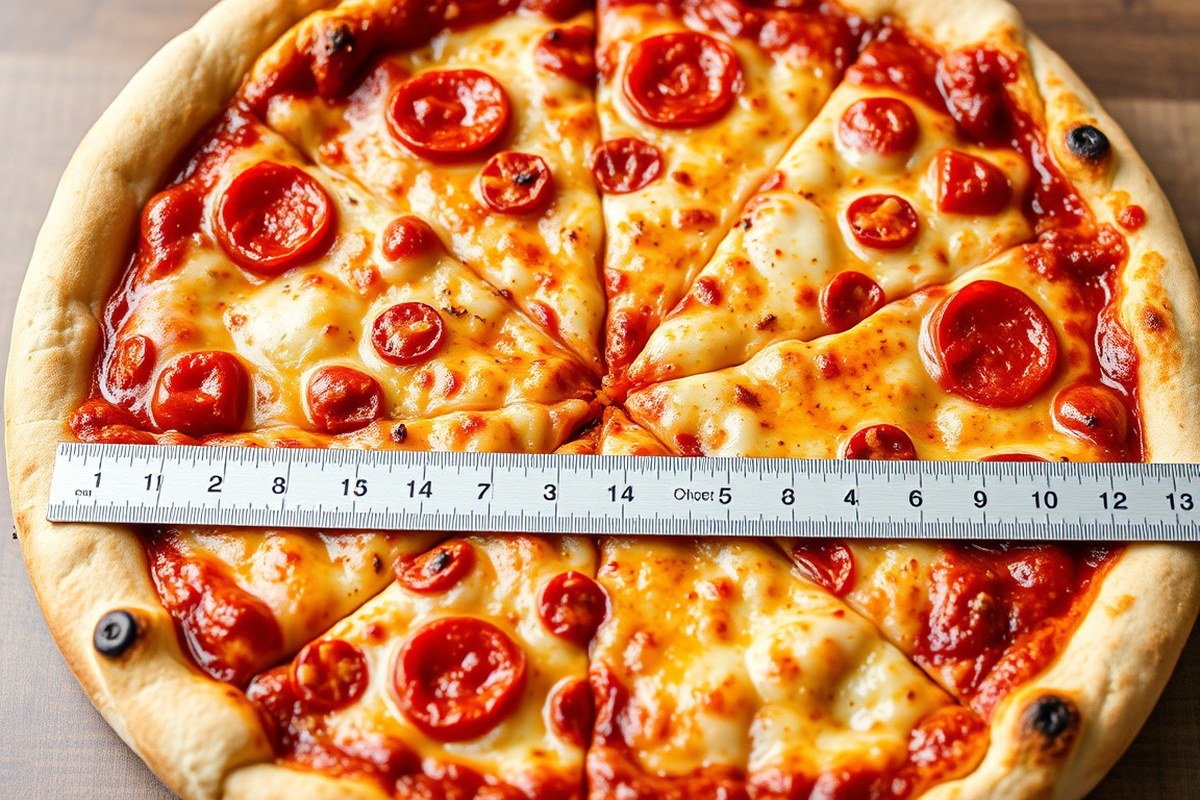
Pizza size in inches refers to the diameter, the distance across the pizza, but the amount of pizza you actually get depends on its area, measured in square inches. This difference matters because the area increases with the square of the radius, which is half the diameter. For example, a 10-inch pizza has a radius of 5 inches. Squaring 5 gives 25, and then multiplying by π (about 3.14159) gives roughly 79 square inches of pizza. This means you get 79 square inches of actual pizza surface to enjoy.
Now, compare that to a 14-inch pizza. Its radius is 7 inches, and squaring 7 gives 49. Multiplying 49 by π results in about 154 square inches, nearly double the 10-inch pizza. This is why a 14-inch pizza has more than twice the food of a 10-inch one, even though the diameter only increased by 4 inches.
Looking at a few more sizes: a 12-inch pizza covers about 113 square inches, and a 16-inch pizza covers approximately 201 square inches. A 16-inch pizza offers more than twice the pizza of a 12-inch pizza because the area jumps quickly as the diameter grows. Going from 8 inches to 16 inches actually quadruples the pizza area, since doubling the diameter doubles the radius, but area grows with the radius squared.
Slice count can be misleading when figuring serving size. Two pizzas might both have eight slices, but if one pizza is a 10-inch and the other is a 14-inch, the slices from the larger pizza will be significantly bigger. For example, an 8-slice 10-inch pizza has slices of about 10 square inches each, but the same slice count on a 14-inch pizza gives slices around 19 square inches each. That difference matters when feeding a crowd or planning portions.
| Pizza Diameter | Radius (inches) | Area (square inches) | Slices | Area per Slice (square inches) |
|---|---|---|---|---|
| 10 inches | 5 | 79 | 8 | 10 |
| 12 inches | 6 | 113 | 8 | 14 |
| 14 inches | 7 | 154 | 8 | 19 |
| 16 inches | 8 | 201 | 10 | 20 |
Calculating the area with the formula π × radius² helps you compare pizzas fairly. For two 10-inch pizzas, the total area is about 158 square inches, which is about the same amount of pizza as one 14-inch pizza. That means two smaller pizzas might provide similar food volume as one large pizza, but this calculation also helps optimize cost and variety. To find the exact amount of pizza for your group, add up the total area needed based on servings, then select the pizza size or combination that comes closest to that number. It is smart to add 15% more area than needed to cover big appetites and leftovers.
Always calculate pizza servings using area, not just diameter or slice count, to avoid underestimating how much food to order.
Calculating How Much Pizza You Need for a Group
To figure out how many pizzas you need for a group, first estimate the total slices based on the number of adults and children and their appetites. Then, convert that slice count into pizza sizes and quantities, and finally add a buffer to cover leftovers. This approach helps avoid ordering too little or too much pizza.
Estimate Slices Needed per Person
Adults generally eat 2 to 3 slices each, depending on how hungry they are. Children usually eat 1 to 2 slices each. These numbers adjust if you have side dishes like salad that reduce pizza consumption.
For example, guests eating only pizza might average 3 slices for adults and 2 slices for kids. But if you are serving a large Caesar salad, you can lower that estimate by about 1.5 slices per person.
Convert Total Slices into Pizza Sizes and Amounts
After estimating slices, determine how many pizzas you need by dividing total slices by slices per pizza. Most medium pizzas (12 inches) have 8 slices, while larger pizzas can have 10 or more. The size and crust also impact how filling each slice is. Using total slices rather than just counting pizzas keeps your order volume accurate and controls waste. Use this method:
- Calculate total slices needed by multiplying adults and kids by their estimated slices.
- Choose your pizza sizes and note how many slices each contains.
- Divide the total slices needed by slices per pizza to find the number of pizzas to order.
Example: For 10 adults (3 slices each) and 5 kids (2 slices each), you need (10×3) + (5×2) = 40 slices. If ordering 12-inch pizzas with 8 slices each, 40 ÷ 8 = 5 pizzas.
Add Leftover Buffer for Safety
Always include an extra 10-20% worth of pizza to ensure no one goes hungry and leftovers are available. This buffer accounts for unexpected appetites and those who prefer extra slices.
Using the example above, add 20% to 40 slices = 48 slices total. Ordering 6 pizzas (48 ÷ 8) provides a comfortable margin without excessive leftovers.
Remember that specialty pizzas, dietary needs, and the presence of side dishes might change these numbers slightly. Adjust your buffer accordingly.
How Appetite, Age, and Side Dishes Affect Pizza Serving Sizes
Adult appetites usually range from two to three slices of pizza each, while younger kids often eat just one to two slices. Children under 10 tend to have smaller portions, so ordering fewer slices for them can reduce waste and cost. For example, a large pizza typically cut into 10 slices can feed about three to four adults or four children. When serving a group with mixed ages, calculate portions by assuming most adults will eat three slices and children one or two, adjusting based on the specific guests’ hunger levels.
Providing appetizers or side dishes changes how much pizza you should order. If guests have access to wings, salads, or other heavy sides, you can reduce the total pizza by about 20 to 25 percent without leaving anyone hungry. For instance, 5-6 wings per person fill up appetites, cutting the need for extra slices. When sides are plentiful, trying to order too many pizzas risks leftovers and extra expense.
Large orders for very hungry groups, like athletes or partygoers known to have big appetites, require increasing your pizza totals. Moving from large (14-inch) to extra-large (16-inch) pizzas helps by adding more cheese, toppings, and slice surface area per pizza. For example, four very hungry adults might share an extra-large instead of a large, or order an additional pizza to keep everyone satisfied.
- Estimate 2-3 slices per adult, 1-2 slices per child under 10
- Cut medium pizzas into 10 slices and large pizzas into 14 slices for children or side servings
- Reduce pizza order by 20-25% when serving substantial appetizers or salads
- Increase order size or quantity for groups with very hungry guests, like teenagers or athletes
- Order smaller pizzas if serving only children or including unique toppings for specific preferences
Considering hunger levels and side dish availability before placing an order helps balance costs and guest satisfaction. Ordering just one extra pizza when guests are extremely hungry can prevent disappointment, while cutting back when heavy appetizers are on the menu saves money. Paying attention to cut sizes and ages improves portion control, too. Following these tips results in enough pizza for everyone, avoiding leftover waste or hunger.
How Different Pizza Cut Styles and Crust Types Affect Serving Size
Crust thickness, cut style, and slice size all impact how you perceive servings on a pizza. A thicker crust generally means more dough and a filling bite per slice, but it may lead to fewer slices. Thin crust pizzas often get cut into more slices since each piece weighs less, but that can make portion control harder if you want consistent serving sizes.
Traditional wedge slices are the most common cut style, usually resulting in 6 to 12 slices depending on pizza size. Square cuts, also known as party cuts, break the pizza into smaller squares or rectangles rather than wedges, increasing the number of pieces without changing the overall amount of pizza. This style works well for groups or snacks because people can take smaller or larger portions easily.
| Pizza Size (Diameter) | Typical Number of Slices | Slice Size (Square Inches) | Cut Style |
|---|---|---|---|
| 7″, 8″, or 9″ | 4 | 38.5 to 64 | Traditional wedges |
| 10″ Small | 6 | ~26.2 | Traditional wedges |
| 12″ Medium | 8 | ~18.1 | Traditional wedges |
| 14″ Large | 8 or 10 | 15.4 to 19.2 | Traditional wedges |
| 16″ Extra Large | 6 or 12 | 16.8 to 33.4 | Traditional or party cuts |
| 18″ Extra Large (e.g., Pizza Hut) | 12 to 14 | 18 to 21 | Traditional wedges |
Pizza places often keep the same slice count across crust types and sizes, so a thick-crust pizza slice might be more filling due to more dough and toppings. On the other hand, a thin crust pizza cut into many smaller, square slices encourages lighter, bite-sized servings. Selecting a cut style depends on your group’s appetite and serving goals. For example, party cuts are great for large groups offering flexible portions, while wedges suit meals needing consistent, plate-sized servings.
Controlling portion size also depends on slice size and how the pizza is cut. Larger slices can make it easy to overestimate servings. Cutting a large 14″ pizza into 10 thin slices rather than 8 wedges gives smaller pieces and better portion control. Thick crust pizzas can feel more substantial, so you might need fewer slices per person than with thin crust varieties.
Practical tip: Request a “party cut” for thick crust or large pizzas to create smaller, more manageable portions and avoid food waste when serving diverse appetites.
Comparing Slice Counts and Serving Sizes Across Major Pizza Chains
Major pizza chains vary in their pizza sizes, slice counts, and portion recommendations. Typically, large pizzas are 14 inches but differ in how many slices they have. Knowing these details helps you order the right amount for your group and prevents either too little pizza or too many leftovers.
Pizza Hut Pizza Sizes and Servings
Pizza Hut’s large pizza measures 14 inches in diameter and is cut into 8 slices. Their medium pizza is 12 inches with 8 slices as well. For groups of 3 to 4 people, one large pizza usually suffices, assuming average appetites of 2 slices per person. Larger groups should consider the number of slices per person to decide how many pizzas to order.
Since Pizza Hut cuts their large into 8 slices, this affects how you estimate servings compared to places that cut more slices. Each slice is roughly 24 square inches, calculated from the whole pizza area. If you want to serve a party of 8 adults, ordering 3 large pizzas allows 2 to 3 slices per person, covering bigger appetites or fewer side dishes.
Domino’s Slice Counts and Recommendations
Domino’s uses a similar sizing and slicing approach as Pizza Hut for their medium and large pizzas. Their 14-inch large pizza is cut into 8 slices. The medium 12-inch usually has 8 slices as well. Domino’s slice sizes tend to be consistent with Pizza Hut, so you can use similar portion estimates between the two chains.
For smaller groups, a medium pizza with 8 slices can feed 3 to 4 people comfortably. A large pizza with 8 slices is better for groups of 4 to 5. Domino’s encourages ordering based on appetite and side dishes; for example, if it’s just adults eating pizza without many sides, plan for 2 to 3 slices each. Ordering more than 10 pizzas may require a 24-hour advance notice to ensure timely preparation, something to consider for larger events.
Little Caesars and Papa John’s Pizza Serving Details
Little Caesars’ popular $5 Hot-N-Ready large pizza is 14 inches and cut into 8 slices, matching the slice count of other chains. Papa John’s offers a similar 14-inch large pizza also cut into 8 slices. Medium pizzas at these chains standardize at 12 inches with 8 slices.
One notable point is that some smaller pizzas, like two 10-inch pizzas from these chains, can provide more total food than a single large, changing your ordering strategy. For a group of 6, two medium or two small pizzas might give more total pizza than one large, which is worth considering depending on appetite size and variety preferences.
| Chain | Large Pizza Size (inches) | Large Pizza Slice Count | Medium Pizza Size (inches) | Medium Pizza Slice Count |
|---|---|---|---|---|
| Pizza Hut | 14 | 8 | 12 | 8 |
| Domino’s | 14 | 8 | 12 | 8 |
| Little Caesars | 14 | 8 | 12* | 8* |
| Papa John’s | 14 | 8 | 12 | 8 |
*Little Caesars medium size may vary by location. This table shows that across major chains, large pizzas typically come as 14 inches cut into 8 slices. While size names match, the number of slices does not increase with diameter beyond that point, so slice size actually changes if you choose bigger pizzas, affecting how you divide servings.
Common Mistakes When Estimating Pizza Servings and How to Avoid Them
One frequent error when estimating pizza servings is thinking a 16-inch pizza is simply twice as big as an 8-inch. In fact, because pizza area grows with the square of the diameter, a 16-inch pizza has about four times the area of an 8-inch pizza. This means it can serve roughly four times as many people, assuming similar appetite sizes and pizza thickness. Always calculate servings based on area, not just diameter.
Another common mistake involves assuming slice count equals servings. Some pizzas, like those from Pizza Hut, offer the same number of slices across different sizes, such as 8, 12, or 16-inch. Larger pizzas just have bigger slices, which doesn’t always translate to more servings if people eat by slice. When ordering, check slice size or estimate servings by total pizza area instead.
Failing to consider who will eat the pizza leads to underestimating how many pizzas you’ll need. Adults, especially with hearty appetites, often eat more slices than children. Children usually eat half to two-thirds as much. Ignoring age and appetite differences can cause shortages or excess. Adjust your order by allocating about 2-3 slices per adult and 1-2 slices per child, depending on how hungry everyone is.
- Assuming pizza size scales linearly with diameter instead of area; fix by calculating area (πr²) for accurate servings.
- Counting number of slices without checking slice size; fix by confirming slice dimensions or estimating servings by total pizza size.
- Not factoring in appetites or age groups; fix by assigning different slice counts per adult and child based on hunger levels.
- Ignoring pizza crust style or thickness, which affects fullness; thin crust means people may eat more slices, so order extra.
- Overlooking local pizza size naming conventions; fix by verifying actual pizza diameter at each place before ordering.
Checking the diameter listed on the menu before ordering reduces confusion, especially since what one restaurant labels “Large” might be 14 inches, while another’s is 16 inches. Also, if a special deal offers two smaller pizzas for the price of a larger one, calculate total pizza area to decide which is the better option. For example, two 10-inch pizzas provide more total pizza than a single 14-inch, so choose accordingly.
One practical tip is to place a large pizza in a central spot so everyone can share easily and prevent one person from taking all the biggest slices. These small planning details help serve your group fairly and avoid running out of pizza mid-party.
Worked Example: How to Calculate Pizzas for a Party of 12 Adults and 5 Kids
For a party of 12 adults and 5 kids, ordering enough pizza means calculating total slices based on appetites, choosing a mix of pizza sizes to match the number of slices, and including some extra slices to account for bigger appetites or seconds. Using typical slice counts for common pizza sizes makes this process straightforward, helping you avoid ordering too little or wasting too much.
Determine Total Slices Needed
Start by estimating how many pizza slices each person will eat. Adults usually eat more than kids, so assume about 3 slices per adult and 1.5 slices per child as a baseline. For 12 adults, multiply by 3 (12 × 3 = 36 slices). For 5 kids, multiply by 1.5 (5 × 1.5 = 7.5 slices). Add these to get the total slices needed: 36 + 7.5 = 43.5 slices. Rounding up is practical, so plan for about 44 slices to satisfy appetites without ordering excessive extras.
Select Pizza Size Combinations
Next, decide which pizza sizes to order based on their slice counts. A standard 14-inch large pizza usually has 8 slices, while a 12-inch medium pizza has 6 slices. Mix and match these to get close to the total slice count needed.
For example, ordering five large pizzas would yield 5 × 8 = 40 slices, which is just under the 44 slices required. Adding one medium pizza adds 6 slices, totaling 46 slices, enough to cover everyone based on the initial estimate.
Add Leftover and Adjust Final Order
Including a buffer of about 10% extra slices protects against appetites that are larger than expected or last-minute guests. Taking 10% of 44 slices gives 4.4 extra slices, rounding to 5 additional slices.
Adding 5 slices beyond your original calculation makes the total 49 slices. Since each large pizza has 8 slices and each medium 6, ordering six large pizzas provides 48 slices, nearly meeting the demand. To be safe, adding one medium pizza brings the total to 54 slices, which allows for a reasonable leftover buffer.
- Estimate slices per person based on appetite: multiply adults by 3 slices and kids by 1.5 slices.
- Add slices from adults and kids to find total slices needed.
- Choose pizza sizes and count their slices (e.g., 14-inch = 8 slices, 12-inch = 6 slices).
- Calculate how many pizzas of each size are needed to reach or slightly exceed the total slice count.
- Add about 10% extra slices as a buffer for leftovers or larger appetites.
- Adjust your pizza count to round to whole pizzas, ensuring total slices cover the estimated need plus buffer.
- Order a mix of pizzas to suit your group’s preferences, such as topping variety or crust types.
Ordering just one pizza size simplifies serving, but mixing sizes helps fit slice needs and budgets better. Keep pizza boxes organized to avoid opening multiple pizzas at once, which keeps slices fresher.
Quick-Start Action Plan for Ordering Pizza by Servings
Use this plan to order the right amount of pizza for your group without overbuying or running short.
- Before ordering: Count your group members and divide them by adults and kids to estimate appetite differences.
- Right after count: Choose pizza sizes based on servings per size from a trusted chart or your favorite pizza place.
- 15 minutes before ordering: Factor in side dishes that may reduce pizza needed and adjust servings accordingly.
- When choosing crust and cut style: Pick options that give more or fewer slices to match your group’s preferences and appetite.
- At order time: Add a small buffer of 10-15% more pizza if your group includes big eaters or if you want leftovers.
- After delivery: Count slices left to learn your group’s actual consumption for future orders.
- Next event planning: Repeat the process using your previous data to order more accurately next time.
Frequently Asked Questions
How Many Servings Are in a 10-inch Pizza?
A 10-inch pizza typically serves 1 to 2 adults. It’s a small size good for one person or sharing with one more if combined with sides.
Can a 12-inch Pizza Feed Three People?
Yes, a 12-inch pizza usually serves 2 to 3 adults. It’s best for small groups, especially when paired with side dishes to satisfy everyone.
How Many Slices Are in a Large 14-inch Pizza?
A 14-inch pizza generally has 8 slices, serving about 3 to 4 adults. The number of slices helps estimate how much each person can eat comfortably.
Does Pizza Crust Thickness Affect Serving Size?
Yes, thicker crust adds volume, which may reduce the number of slices you eat. Thin crust pizzas often mean more slices per person.
How Many Pizzas Do I Need for a Party of 10 Adults?
You’ll likely need 4 to 5 large (14-inch) pizzas for 10 adults, assuming average appetites and some side dishes. Adjust for very hungry or light eaters.
Why Does Pizza Diameter Not Directly Reflect Serving Size?
Pizza size in inches measures diameter, but the surface area grows with the square of the radius, affecting how many people it can feed depending on slice size.
Final Thoughts
Knowing how many servings are in each pizza size helps you order pizza that fits your group perfectly without waste. Start by identifying your group’s appetite and picking sizes and cuts that match their needs. Taking these steps prepares you to serve pizza that everyone enjoys and finishes, saving money and hassle. Make your next pizza order confident and precise by applying what you learned today.