Microwave Oven With Convection: a Complete Buying Guide
Many people struggle to find a kitchen appliance that offers both quick cooking and even heating. If you love the convenience of microwave speed but want the quality of oven results, a convection microwave oven is a game-changer. You’re not alone in wanting a versatile device that can roast, bake, and grill with ease.
You’ll want a convection microwave oven that blends microwave speed with convection’s even heating for roasting, baking, and grilling. Look for models with 700 to 1200 watts, multiple power levels, and sensor cooking to guarantee precise results.
Choose a size that fits your kitchen and meal prep needs, from compact to large capacity. Top brands like Panasonic and Samsung offer smart features for efficiency.
Keep your oven well-ventilated and maintained to avoid issues. Investigate further to access tips on installation, cleaning, and cooking techniques.
Key Takeaways
- Convection microwaves combine microwave and convection heating for faster, even cooking with browning, making them great for baking, roasting, and grilling.
- Higher wattage (700-1200W) and multiple power levels boost cooking speed, precision, and versatility for different foods.
- Pick a size and capacity based on your kitchen space and meal prep needs, from compact models to larger ones with multi-rack options.
- Top brands like Panasonic, Samsung, and Breville offer advanced features such as inverter technology, sensor cooking, and smart oven functions.
- Proper installation with good ventilation, regular cleaning, and troubleshooting help keep your microwave safe and prolong its lifespan.
How a Convection Microwave Oven Works
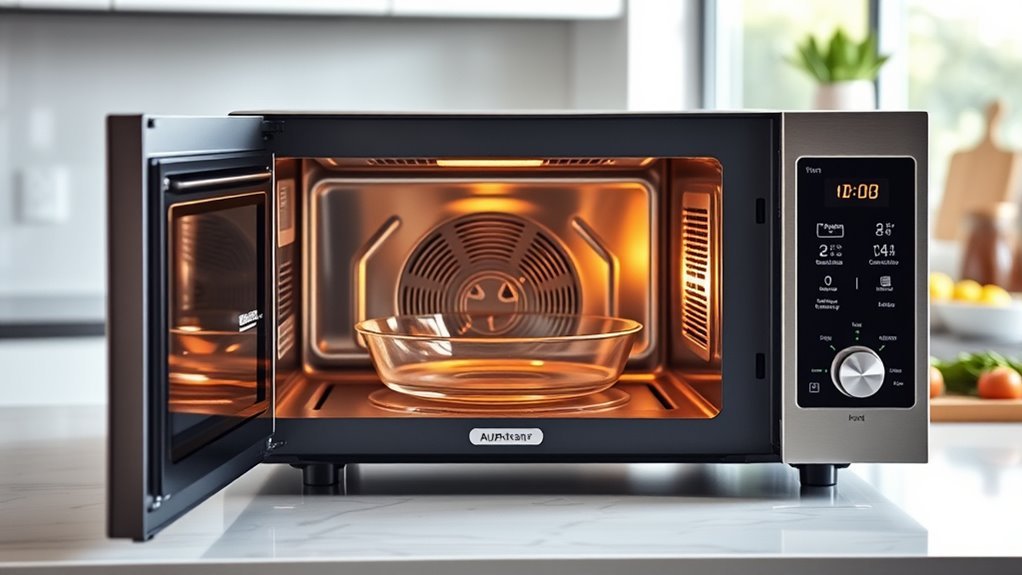
Although convection microwave ovens look like regular microwaves, they combine traditional microwave heating with a built-in fan and heating element. This helps cook food more evenly and quickly.
When you use one, microwave technology heats your food from the inside out by agitating water molecules. Meanwhile, convection heating circulates hot air around the food.
This dual approach guarantees thorough cooking and browning, which regular microwaves often can’t achieve. You’ll notice that the fan and heating element work together to maintain a consistent temperature and airflow.
This allows for roasting, baking, and crisping. So, you’re not just reheating leftovers—you can prepare meals that need even cooking and good texture.
Benefits of Using a Convection Microwave Oven
When you choose a convection microwave oven, you can cook a wider variety of dishes quickly without sacrificing quality. It combines microwave and convection heating, offering versatility that standard microwaves don’t have. You can bake, roast, grill, and reheat food all in one compact unit.
Beyond being versatile, convection microwaves are energy-efficient. They cook food faster than traditional ovens, which helps reduce energy use. The fan circulates hot air evenly, speeding up cooking times and giving you consistent browning.
Using a convection microwave also frees up your regular oven for larger meals or other tasks. It’s a space-saving, convenient solution for busy kitchens. Overall, it offers speed, efficiency, and multi-functionality—making it a smart choice for everyday cooking.
Essential Features to Consider in a Convection Microwave
When you’re picking out a convection microwave, it’s a good idea to pay attention to the power levels and wattage. That way, you can be sure it’ll cook your food efficiently and evenly. Nobody wants a microwave that takes forever or doesn’t quite get the job done, right?
Also, take a look at the different cooking modes and functions it offers. The more versatile it is, the better it will suit your cooking needs. These features can really make a difference in how well your microwave performs and how much you enjoy using it.
Power Levels And Wattage
Understanding power levels and wattage is key when choosing a convection microwave because they directly affect cooking speed and food quality. Higher wattage means faster cooking and more even heating, but you’ll also want to think about energy efficiency to save power.
When comparing models, checking wattage helps you find the right balance between performance and electricity use. Microwaves usually range from 700 to 1200 watts, with higher wattage cooking quicker.
Multiple power levels let you adjust the heat precisely for different foods. Efficient models give consistent results without wasting energy.
Cooking Modes And Functions
Although power and wattage are important, it’s also helpful to look into the cooking modes and functions your convection microwave offers to get the most out of it. Different techniques like grilling, baking, roasting, and defrosting really open up your meal options.
The more versatile the functions, the easier it is to try out new recipes and get consistent results. Look for presets for common dishes—they make cooking simpler and save you time. Some models even have sensor cooking that automatically adjusts settings based on moisture and temperature.
Choosing a convection microwave with a variety of cooking modes lets you unlock its full potential and makes your kitchen experience much more enjoyable without needing extra appliances.
Convection Microwave Ovens vs. Traditional Microwaves
How do convection microwave ovens differ from traditional microwaves, and which one suits your kitchen needs better? Traditional microwaves are great for quick reheating and simple cooking, mainly using microwave energy. Convection microwave ovens, on the other hand, combine microwave energy with a heating element and a fan, making cooking more efficient and versatile.
With a convection microwave, you can bake and roast food with even browning and crispiness. You can also cook meals faster by combining convection heat with microwaves. Plus, you get one appliance that can do multiple cooking methods, saving space in your kitchen.
If you want more than just reheating and basic cooking, a convection microwave offers greater flexibility. But if your needs are simple and you prefer quick results, a traditional microwave might be enough. Think about your cooking habits to decide which style fits your lifestyle best.
Best Sizes and Capacities for Your Kitchen Needs
When picking out a microwave, it’s all about finding the right size for your kitchen and how you like to cook. If your counter space is a bit tight, a compact microwave is a smart choice—it doesn’t take up much room but still gets the job done.
On the other hand, if you want something a little more versatile for daily use, a medium-sized microwave might be perfect. It gives you enough space for most dishes without being too bulky.
And if you’re cooking for a family or love preparing larger meals, then a big capacity microwave is the way to go. It can handle bigger dishes with ease, making your cooking process much simpler.
Compact Models For Small Spaces
When space is tight, choosing a compact microwave model can really make a difference in your kitchen’s functionality. These space-saving designs fit perfectly in small kitchens, dorm rooms, or office spaces without sacrificing performance.
You’ll find plenty of countertop options that maximize your available area while offering convection cooking benefits.
Look for models that offer under 1.2 cubic feet capacity, which is ideal for reheating and small meals.
Slim profiles that fit narrow shelves or corners easily are also a plus.
And consider multi-function settings that combine microwave and convection baking to get the most out of your space.
Medium Sizes For Versatility
Choosing a microwave with a capacity between 1.2 and 2.0 cubic feet offers a great balance of size and functionality for most kitchens.
This medium size is versatile enough for reheating leftovers or baking small casseroles without taking up too much counter space.
It has enough room for larger plates and dishes, so you won’t have to compromise on meal prep.
Plus, it fits comfortably in standard kitchen spaces, helping you make the most of your space while still offering powerful convection features.
If you want a microwave that adapts to different cooking needs without crowding your kitchen, this size is a perfect choice.
It’s your go-to option for flexibility and efficiency without sacrificing space or performance.
Large Capacity For Families
Although larger microwaves take up more space, they offer the capacity and power families need to prepare multiple dishes at once. If you often handle family meal prep or enjoy bulk cooking, a spacious microwave oven with convection can be a real game-changer.
It lets you cook bigger meals efficiently without juggling batches. Look for models with a capacity of 1.5 to 2.2 cubic feet, so you can fit large casserole dishes with ease.
A high wattage of 1000W or more guarantees even and quick cooking. Multiple rack levels are also helpful, allowing you to heat or bake several items at the same time.
Choosing the right size means you won’t have to compromise on speed or space. This makes your kitchen workflow smoother and your meal prep less stressful.
For busy households aiming to save time and serve hearty meals effortlessly, investing in a large capacity microwave is a smart move.
Choosing the Right Power and Cooking Modes
How do you guarantee your microwave cooks food evenly and efficiently? Start by choosing the right power level and cooking modes tailored to your needs. A microwave with adjustable power settings lets you control cooking precision, making sure delicate dishes don’t overcook and frozen meals heat thoroughly.
Look for models offering multiple power levels, typically ranging from 600 to 1200 watts. This helps you balance power efficiency with performance. Besides power, check for versatile cooking modes like convection, grill, and combination settings. These expand your cooking options, letting you bake, roast, or grill, not just reheat.
A convection microwave with smart sensors can automatically adjust time and power, improving cooking precision and saving energy. Prioritize a microwave that combines power efficiency with flexible modes. This way, you get consistent results while minimizing electricity use and cooking time.
This approach guarantees you cook meals evenly, efficiently, and exactly how you want.
Best Convection Microwave Oven Brands and Models in 2024
Finding the best convection microwave oven in 2024 means looking for models that combine power, versatility, and smart features. You want top-rated brands that deliver consistent performance and innovative features to improve your cooking experience.
This year, several brands stand out for their reliability and cutting-edge technology.
Consider these top-rated brands and models:
- Panasonic NN-CD87KS: Known for its inverter technology and multi-stage cooking.
- Samsung MC12J8035CT: Offers a ceramic enamel interior and smart sensor cooking.
- Breville BOV900BSS: Combines convection with smart oven functions and Element IQ technology.
Each of these models brings innovative features like sensor cooking, multiple power settings, and convection capabilities that make meal prep efficient and enjoyable.
Installation and Maintenance Tips for Convection Microwaves
Make sure your convection microwave has good ventilation. It’s important so it can run smoothly and safely. Think of it like giving your microwave enough space to breathe!
And don’t forget about cleaning. Giving it a regular wipe-down helps it stay in tip-top shape and can even make it last longer. Just a quick clean now and then makes a big difference.
Let’s go over some easy tips for installing and caring for your microwave so it keeps working perfectly for a long time.
Proper Ventilation Setup
Since convection microwaves generate more heat than standard models, proper ventilation during installation is really important to keep everything running smoothly and safely. You need to follow specific ventilation requirements to ensure there’s enough air circulation.
Without good ventilation, your microwave might overheat or not work as efficiently. When setting up the ventilation, keep these points in mind: install your microwave in a space with clear airflow paths to prevent heat buildup.
Avoid enclosing the unit tightly; leave gaps as recommended by the manufacturer. Position exhaust vents or fans so they can effectively remove hot air from the kitchen area.
Cleaning and Care Tips
Although convection microwaves are built to last, regular cleaning and proper care help them perform at their best and last longer. Simple cleaning routines can prevent buildup and keep your microwave hygienic.
Make it a habit to check seals and vents regularly. This simple step can help you avoid costly repairs down the line. Always unplug the microwave before cleaning and use a soft cloth with mild detergent.
Avoid harsh chemicals that might damage the interior. Instead, wipe the inside after every use and clean the exterior weekly. Check door seals monthly and inspect vents every three months.
Don’t forget to deep clean the convection fan every six months. Staying on top of these tips will keep your microwave efficient and safe for daily use.
Fixing Common Problems With Your Convection Microwave
When your convection microwave stops heating evenly or the turntable won’t rotate, it’s important to troubleshoot quickly to avoid bigger issues. Convection problems usually come from simple issues like faulty parts or incorrect settings. Use these tips to get your microwave working properly again.
First, check if the turntable is aligned correctly and the roller ring is in place. Misalignment can stop the turntable from rotating. Next, inspect the heating element and fan for damage or blockages, as these can cause uneven heating.
Ensure the turntable and roller ring are properly aligned; check heating elements and fan for damage or blockages.
You can also try resetting the microwave by unplugging it for a few minutes. This helps clear minor glitches that might be affecting performance. If these steps don’t fix the problem, refer to your user manual or call a professional technician.
Addressing convection issues early can prevent costly repairs and keep your microwave running smoothly. Staying proactive ensures your convection microwave continues to deliver great cooking results without interruptions.
Recipes and Cooking Tips for Convection Microwaves
If you want to get the most out of your convection microwave, learning some simple recipes and cooking tips can make a big difference. Start by exploring convection recipes designed specifically for these ovens, like roasted vegetables, baked chicken, or homemade pizzas. These recipes take advantage of the even heat distribution and faster cooking times your convection microwave offers.
When it comes to cooking techniques, always preheat the convection function before placing your food inside. Use microwave-safe cookware that allows air circulation for crispier results. Adjust cooking times and temperatures slightly lower than traditional ovens to prevent overcooking. Rotate or stir dishes midway to guarantee even cooking.
Also, avoid overcrowding the oven, as this can block heat flow and affect results. By following these tips and experimenting with convection recipes, you’ll enjoy healthier, tastier meals cooked faster and more efficiently in your convection microwave.
Frequently Asked Questions
Are Convection Microwaves More Energy-Efficient Than Regular Ovens?
Yes, convection microwaves are generally more energy-efficient than regular ovens. They combine microwaving and convection heating, which shortens cooking times.
This means you use less power overall and cook faster. Plus, they heat food more evenly, so you don’t need to reheat as much.
If you want to save on energy bills while cooking quickly, a convection microwave is a smart choice.
Can I Use Metal Cookware in a Convection Microwave?
You generally shouldn’t use metal cookware in the microwave mode because it can cause sparks or damage.
However, with convection cooking, you can use metal cookware if you follow certain guidelines—like avoiding metal that touches the microwave walls and using shallow pans.
For safe convection cooking, stick to oven-safe metal pans and keep an eye on your food. Preheating and monitoring will help prevent burning or uneven cooking.
How Long Is the Typical Warranty for Convection Microwave Ovens?
You’ll usually find that the typical warranty for convection microwave ovens lasts about one year, covering most defects and malfunctions.
However, warranty coverage can vary, so it’s smart to read the warranty terms carefully before buying. Some brands offer extended warranties or additional coverage for parts and labor.
Always check what’s included so you know exactly how long your appliance is protected and what repairs or replacements are covered.
Do Convection Microwaves Require Special Electrical Outlets?
No, convection microwaves usually don’t need special electrical outlets. Most are designed to work with standard kitchen outlets, which are typically 120 volts in the US.
That said, it’s a good idea to check the manual for specific electrical requirements. Some high-powered models might need a dedicated circuit or a certain amperage.
Always make sure your outlet matches the microwave’s power needs. This helps prevent any electrical problems or performance issues.
Are Convection Microwave Ovens Safe for Children to Use?
Yes, convection microwave ovens are generally safe for children to use if you follow proper safety measures.
It’s important to teach kids about safe cooking habits like using oven mitts, setting the right cooking times, and avoiding metal inside the oven.
Always supervise them closely to prevent burns or mishandling.
With proper guidance, they can use the oven safely while also learning useful cooking skills.
Conclusion
Choosing a convection microwave oven is like planting a versatile tree in your kitchen garden. It grows with your needs, offering shade, fruit, and beauty.
By understanding how it works, its features, and how to care for it, you’ll cook delicious meals with ease.
Just like a well-tended tree thrives, your convection microwave will become a reliable companion in your kitchen. It blends convenience and flavor seamlessly.
So, go ahead and let this kitchen marvel transform your cooking. With a convection microwave oven, every meal can be a rewarding experience.