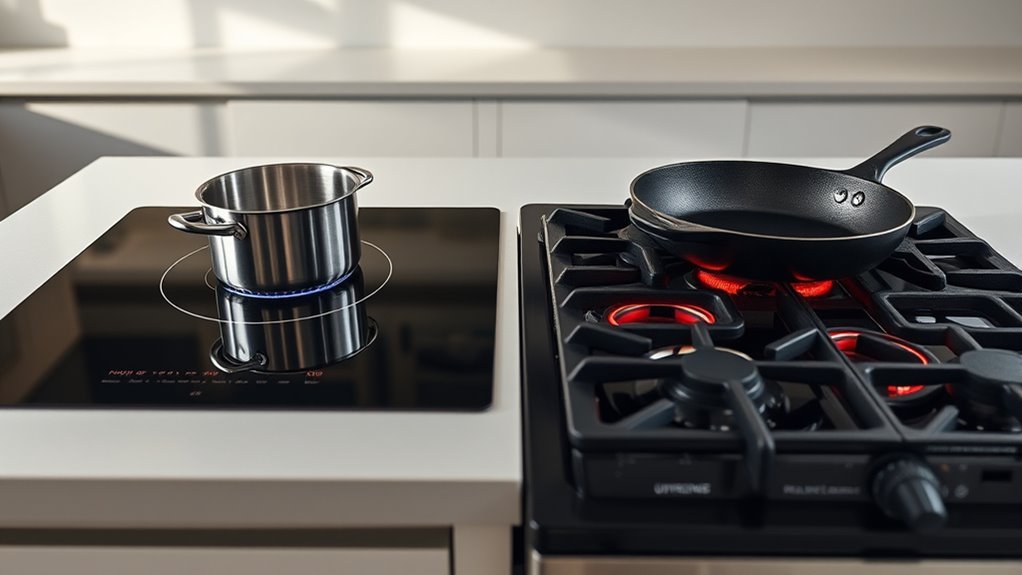
Induction Range vs. Electric Range: Which Is Better?
Are you tired of waiting forever for your stove to heat up or struggling with uneven cooking? You’re not alone—many home cooks find choosing the right range confusing.
With so many options, it’s hard to know which one will make your time in the kitchen easier and more enjoyable.
If you want fast, even heating with precise temperature control, an induction range is your best bet. It heats cookware directly, saving energy and cooking time, while staying cool and safer to use.
Electric ranges cost less upfront and work with most cookware but heat slower and less evenly. Induction might need special pots and a stronger electrical setup.
Keep exploring to find which fits your kitchen and cooking style perfectly.
Key Takeaways
- Induction ranges heat cookware faster and more evenly than electric ranges, which can improve cooking performance and cut down on cooking time.
- They also offer precise temperature control with instant adjustments, while electric ranges tend to respond more slowly and can have fluctuating heat.
- Induction cooktops are more energy-efficient but usually come with higher upfront costs. Electric ranges are generally cheaper but less efficient.
- With induction, you need magnetic cookware, but electric ranges work with almost any type of cookware, giving you more options.
- Cleaning is easier on induction cooktops because they cool quickly and shut off automatically when the cookware is removed, making them safer too.
How Do Induction and Electric Ranges Heat Your Food Differently?
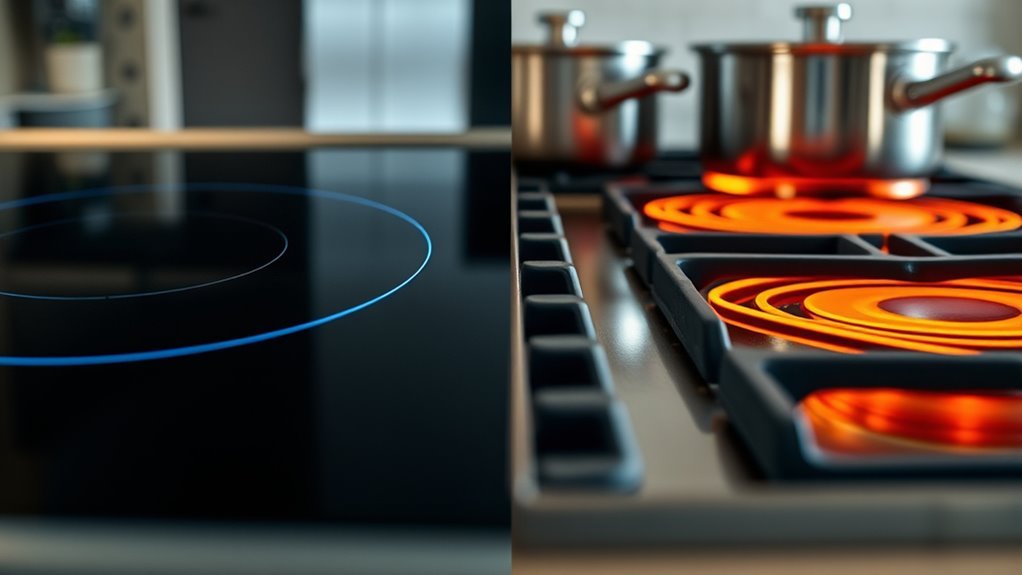
Although both induction and electric ranges rely on electricity, they heat your food in very different ways. When you use an electric range, electric heating elements warm up and then transfer heat to your cookware through direct contact. This process heats your pots and pans gradually, relying on the element’s temperature to cook your food.
In contrast, induction works by generating heat directly inside the cookware itself. Induction ranges create a magnetic field that induces electric currents within the metal of your pan, causing it to heat up instantly. This makes the cooktop stay relatively cool while your food heats faster and uses less energy.
Which Stove Offers Better Temperature Control and Precision?
How precisely can you control the heat when cooking on induction versus electric ranges? With induction stoves, you get exceptional temperature stability and precise adjustments. The magnetic technology responds instantly when you change settings, allowing you to fine-tune the heat with minimal delay. This means you can switch from a rapid boil to a gentle simmer quickly and accurately, giving you greater control over your cooking.
On the other hand, electric ranges rely on heating elements that take longer to adjust, which can cause temperature fluctuations. When you increase or decrease the heat, there’s a lag before the element reaches the new setting, making precise adjustments more difficult. Maintaining consistent heat, especially for delicate dishes, can be a challenge.
In short, if you want quick, precise temperature control and stable heat, induction ranges have a clear advantage over traditional electric stoves.
How Do Induction and Electric Ranges Compare in Cooking Performance?
When you cook on induction and electric ranges, you’ll notice clear differences in performance that affect your overall experience. Induction ranges heat cookware directly, making cooking faster and giving you better control over food texture.
Electric ranges take longer to heat up and cool down. This can impact your timing and the consistency of your dishes.
| Feature | Induction Range | Electric Range |
|---|---|---|
| Cooking Speed | Rapid heating, saves time | Slower to heat, longer cooking time |
| Heat Distribution | Even, precise | Less even, can have hot spots |
| Food Texture | More consistent, less overcooking | Variable, risk of uneven cooking |
| Temperature Adjustment | Instant response | Slower to adjust |
| Energy Use in Cooking | Efficient heat transfer | More heat loss |
Choosing induction means sharper performance and better texture control. Electric ranges may need more attention during cooking.
Which Stove Saves You More Energy?
Thinking about which stove will save you more energy? Well, if you’re torn between an induction and an electric range, it’s good to know that induction stoves usually waste less heat. That means they’re often more efficient and can help cut down your energy bills in the long run.
Energy Efficiency Comparison
Although both induction and electric ranges rely on electricity, induction stoves heat your food more directly and efficiently. This means you’ll use less energy to cook your meals.
Induction technology generates heat within the cookware itself, which minimizes wasted energy. Electric ranges, on the other hand, lose more heat to the surrounding air.
This difference significantly reduces your overall energy consumption with induction. When thinking about sustainability, induction ranges often come out ahead because they use less energy and lower your carbon footprint over time.
Operational Cost Differences
Understanding the operational costs of your stove can help you save money on energy bills over time. When you compare induction ranges to traditional electric ranges, the savings become clear.
Induction stoves use electromagnetic energy to heat cookware directly, which means less wasted heat and faster cooking times. This efficiency leads to lower electricity consumption and helps cut your monthly energy expenses.
A thorough cost analysis shows that although induction ranges may cost more upfront, their energy efficiency usually lowers your long-term utility bills. Electric ranges tend to lose more heat to the surroundings, resulting in higher energy use.
If you want to save on energy costs, choosing an induction range is a smarter option. It offers better operational savings and is generally a more cost-effective cooking solution in the long run.
Upfront and Long-Term Costs Compared
Choosing between an induction range and an electric range often comes down to upfront and long-term costs. Induction ranges usually have higher upfront costs because of the advanced technology involved. You might also spend more on installation if your kitchen isn’t already set up for induction.
However, induction’s energy efficiency can save you money in the long run on your energy bills. Electric ranges tend to have lower initial costs and are simpler to install, but their energy use is less efficient. So, your bills might be higher over time.
Induction saves energy and cuts long-term costs, while electric ranges are cheaper upfront but less efficient over time.
When it comes to maintenance, induction ranges often need less upkeep because they have fewer parts that can wear out. Electric ranges can be more prone to issues with coils or heating elements.
Plus, induction ranges generally hold better resale value thanks to their efficiency and modern look. Considering these factors can help you choose the option that fits your budget and lifestyle best.
What Installation Needs and Compatibility Should You Know?
Before you pick out your new range, it’s a good idea to check what kind of electrical setup your kitchen needs. You want to make sure your space can handle the new appliance without any hiccups.
Also, take a look at the size of the area where you’ll put the range and consider the ventilation. Good airflow is key to keeping everything safe and running smoothly. And don’t forget, you’ll want to see if your current cookware will work with the new stove or if you might need to get some new pots and pans.
Electrical Requirements Comparison
Both induction and electric ranges require specific electrical setups to work safely and efficiently in your kitchen. You’ll want to check wiring requirements and circuit specs to match each appliance’s amperage needs and voltage.
Induction ranges often need a stronger power supply because of their higher energy needs. Understanding your home’s energy source and the appliance ratings can help you avoid installation problems.
Make sure your home’s wiring and circuit breaker can handle the required amperage. Also, check that the voltage is compatible to prevent electrical issues.
Verify that the power supply matches the range’s energy source demands. Finally, consult the installation guides for detailed circuit specs and safety standards.
Space and Ventilation Needs
When installing an induction or electric range, you’ll need to carefully consider space and ventilation requirements to ensure optimal performance and safety. Both types need enough clearance around them to prevent overheating and to make cooking and maintenance easier.
Pay close attention to ventilation needs. Induction ranges usually produce less heat, so they might require less aggressive ventilation compared to electric ranges. However, proper airflow is still crucial for removing heat and cooking fumes effectively.
Measure your kitchen space to make sure the range fits comfortably without crowding other appliances or work surfaces. Checking manufacturer guidelines for minimum clearances and ventilation helps prevent installation problems and keeps your kitchen safe and functional.
Cookware Compatibility Considerations
Choosing the right cookware is key to making your induction or electric range work efficiently. For induction ranges, you need cookware that’s magnetic, like cast iron or stainless steel. Non-magnetic pots won’t heat up unless they pass induction testing, which you can check easily with a magnet at home.
Electric ranges are a bit more flexible and work with almost any cookware. Keep these tips in mind for compatibility: use flat-bottomed cookware for even heating on both types. Avoid warped or damaged pans to ensure good contact. If you’re switching from electric to induction, verify that your cookware materials are suitable.
It’s also a good idea to test new pots or pans with a magnet before purchasing. These steps help ensure your cookware works perfectly with your range and performs at its best.
What Cookware Works Best With Induction and Electric Ranges?
How do you know which cookware suits your induction or electric range best? It all comes down to cookware materials and their magnetic properties. Induction ranges require cookware with strong magnetic bases—like cast iron or certain stainless steels—to work properly. Electric ranges, however, are more versatile and work well with most cookware types, including aluminum and copper.
Heat conductivity is also important. Copper and aluminum heat quickly and evenly but often lack magnetic properties, so they may not work on induction stoves unless they have a magnetic layer added. Consider the weight of your cookware too; heavier pans usually retain heat better, which is helpful for both types of ranges.
| Cookware Material | Ideal Range Type |
|---|---|
| Cast Iron | Induction & Electric |
| Aluminum | Electric |
| Stainless Steel | Both (if magnetic) |
Choosing cookware that balances these factors can help you get the best performance on your stove.
Safety Features Unique to Induction and Electric Stoves
You’ll see that induction and electric stoves each come with their own safety features to help keep your kitchen safe. For example, induction cooktops have really precise heat control, which means they heat up quickly but also cool down fast, reducing the risk of burns. Both types usually include child safety locks, so little hands can’t accidentally turn on the stove or change the settings. Let’s take a closer look at how these features work to keep you and your family protected.
Heat Control Mechanisms
Although both induction and electric ranges generate heat to cook your meals, their heat control mechanisms differ greatly, especially when it comes to safety. Induction technology provides precise temperature response by directly heating cookware, which makes cooking more efficient and enjoyable.
Electric elements rely on heating coils that take longer to change temperature, affecting how heat is distributed and how well you can control energy output.
Knowing these differences is important for understanding performance and keeping your kitchen safe.
Induction stops heating immediately when you remove cookware, reducing the risk of burns. Electric elements stay hot longer, so you need to be careful even after turning them off.
Induction’s quick temperature adjustments help you cook with more precision. Electric ranges often have residual heat indicators to warn you when surfaces are still hot.
Considering these factors helps you find a good balance between safety and cooking performance in your kitchen.
Child Safety Locks
A key safety feature that sets induction and electric stoves apart is their child safety locks. These locks prevent little hands from accidentally turning on burners, greatly reducing the risk of burns or fires.
When choosing between an induction range and an electric stove, look closely at the child accessibility features each model offers. Induction stoves often have more advanced locks that disable the entire cooktop or specific burners.
Some electric ranges may only lock the control panel. These differences can impact your kitchen’s safety ratings and peace of mind.
Cleaning and Maintenance: Induction vs. Electric Ranges
When comparing cleaning and maintenance, induction ranges often save you time and effort because their smooth, flat surfaces resist spills and stains better than traditional electric coils.
You’ll find that induction cooktops require less scrubbing, thanks to their glass-ceramic surface materials, which also make stubborn stains easier to remove. Electric coil ranges have more crevices that trap food, making cleaning a bit more involved.
To keep either appliance in top shape, follow these maintenance tips: use gentle, non-abrasive techniques to protect surfaces, wipe spills immediately to prevent stains, and regularly check and clean the drip pans and coils on electric ranges.
Consider your user preferences. If ease of cleaning is a priority, induction might be your best bet.
Choosing the Right Range for Your Cooking Style and Budget
How do you decide which range suits your cooking style and budget best? Start by thinking about your cooking habits, meal types, and culinary techniques.
If you love quick, precise cooking, induction might be your best choice. But if budget constraints or your kitchen layout are tight, an electric range could be a better fit.
Also, consider your lifestyle changes and energy goals to find a range that works for the long term.
| Factor | Induction Range |
|---|---|
| Cooking Habits | Fast, precise, energy-efficient |
| Budget Constraints | Higher upfront cost |
| Kitchen Layout | Needs compatible cookware |
| Factor | Electric Range |
| User Preferences | Traditional feel, versatile |
| Meal Types | Great for slow cooking |
| Energy Goals | Less efficient, lower upfront cost |
Weigh these factors carefully to pick the range that matches your style and budget perfectly.
Frequently Asked Questions
Can Induction Ranges Interfere With Pacemakers or Other Medical Devices?
You don’t need to worry much about safety concerns with induction ranges interfering with pacemakers or other medical devices. These ranges emit low-level electromagnetic fields, which generally don’t affect device compatibility.
However, if you have a pacemaker or sensitive medical equipment, it’s smart to check with your doctor or the device manufacturer to make sure it’s safe for you.
Taking these precautions can help you avoid any potential risks confidently.
Do Electric Ranges Emit Any Harmful Radiation or Gases?
Radiation risk? Relax! Electric ranges don’t emit any harmful radiation or gases, so they’re safe for your kitchen.
Unlike gas stoves that burn fuel and produce combustion gases, electric ranges cook cleanly with electric coils or smooth tops. You won’t have to worry about invisible irritants or poor air quality.
How Loud Are Induction Ranges Compared to Electric Ranges During Use?
You’ll find that induction ranges produce slightly higher noise levels than electric ranges, mainly because of the buzzing or humming from the electromagnetic field.
But don’t worry, this sound is usually pretty low and not disruptive.
Even with the mild noise, induction ranges heat up faster and use less energy, making them more efficient.
Are There Any Common Repairs Needed for Induction Versus Electric Ranges?
When your range stumbles, it’s like a dancer missing a beat. For induction, common issues include coil or sensor failures, which can increase repair costs because of specialized parts.
Electric ranges often face heating element wear or thermostat problems, and these tend to be cheaper to fix.
You’ll find induction repairs pricier but less frequent, while electric ranges might need more regular tune-ups.
Knowing these common issues can help you prepare for potential repair costs down the road.
Can Either Range Type Be Used During a Power Outage With Alternative Energy Sources?
You can use either range during a power outage if you have a reliable power backup, like a generator or battery system.
Induction ranges are more energy efficient, so they’ll draw less from your alternative energy sources, helping your backup last longer.
However, both need electricity to work, so without power backup, neither will function.
Planning your energy backup carefully guarantees you keep cooking even when the grid goes down.
Conclusion
Now that you know how induction and electric ranges differ in heating, control, energy use, and costs, the real question is which one fits your kitchen best. Will you prioritize precision and speed or lean toward affordability and familiarity? The choice isn’t just about cooking; it’s about transforming your entire cooking experience.
So, before you decide, think carefully. Your perfect stove might be waiting just around the corner, ready to change how you cook forever. Whether you go for induction or electric, making the right choice can make a big difference in your daily cooking routine.